
Most goals for the new year fail for the same reason: they are too big to do on a Tuesday. "Get healthy" is not something you can do today. "Drink a glass of water before coffee" is.
So this list is deliberately small. Below are 60 goals for 2027, grouped by area, each one concrete enough that you'll know at bedtime whether you did it. After the list comes the part that matters more: how to keep a new year goal past the second week of January, when most people quietly stop.
How to use this list
Don't pick ten. Pick one, maybe two. A single goal you keep for 12 months will change more than a dozen you abandon by February.
Read through, notice which idea makes you think "I could actually do that," and start there. If you want a theme to hang the year on, pair it with a word of the year. If you'd rather commit in month-sized chunks, our monthly goals ideas break the year into twelve smaller starts.
Health goals for the new year
- Drink a glass of water before your first coffee. Put the glass next to the kettle the night before so the cue is already waiting.
- Be in bed by the same time five nights a week. Pick the time, not the hours of sleep. The time is the part you control.
- Eat one portion of vegetables at lunch. Not every meal. Just lunch, which is the meal most people improvise.
- Take a 10-minute walk after dinner. Short enough to survive rain, long enough to feel.
- No phone in the bedroom. Buy a cheap alarm clock. Charge the phone in the kitchen.
- Try a month without alcohol. Dry January with friends is the easiest version, because so many people are doing it at the same time. Alcohol Change UK runs the official programme and has good guidance if you drink heavily.
- Floss every night. The classic small habit, and a good one to practice "never miss twice" on.
- Book the checkups you've been putting off. A one-off goal: dentist, eye test, GP. Do it in the first week of January and it's done for the year.
Fitness goals for the new year
- Move for 20 minutes a day. Walking counts. The point is a floor you can't fail, not a training block.
- Do 10 push-ups every morning. Kneeling push-ups count. Add one a week.
- Hit a daily step target. Pick a number about 1,000 above your current average, not a round 10,000 you've never hit.
- Run three times a week. If you're new, follow a beginner walk-run plan rather than "just running."
- Stretch for five minutes before bed. Easy to attach to brushing your teeth.
- Join a January workout challenge. A January workout challenge gives you 31 days with a clear end, which is far easier to start than "get fit in 2027."
- Take the stairs, always. No decision to make each time, which is the point.
- Train for one event. A 5K, a charity walk, a long bike ride. A date on the calendar turns a vague goal into a plan.
Mind and wellbeing goals
- Write down three good things each evening. Two minutes, in a notebook on your pillow.
- Meditate for five minutes a day. Use a free guided session. Five minutes, not twenty.
- No phone for the first 30 minutes after waking. The morning stays yours.
- Spend 20 minutes outside every day. Daylight helps more in winter than you expect.
- Journal one sentence a day. One sentence is enough to keep the habit alive on bad days.
- Pray or read scripture daily. If faith is central for you, a group fast like a 21-day Daniel fast can be a strong start to the year. Talk to your doctor first if you have a health condition.
- Have one screen-free evening a week. Same night each week, so it becomes routine.
- Say no to one thing a week. A small, practical boundary goal.
Money goals for 2027
- Track every purchase for 31 days. Not budgeting, just noticing. The awareness does most of the work.
- Move a fixed amount to savings on payday. Automate it so you only decide once.
- Cancel one unused subscription a month. Twelve by December.
- Have a no-spend weekend once a month. Plan free things in advance, or it becomes a weekend of resisting.
- Bring lunch from home three days a week. Three, not five. Leave room for real life.
- Build a starter emergency fund. Pick a small target first, like one month of rent.
- Wait 48 hours before any non-essential purchase over a set amount. Write it on a list. Most items fall off.
- Check your bank balance every Sunday. Five minutes. It stops January's surprises from becoming March's problems.
Relationship goals
- Text one friend every day. Not a plan, just a "thought of you."
- Call a parent or grandparent every week. Same day, same time.
- Have a weekly no-phones dinner with your partner or family. One meal, not all of them.
- Plan one thing with friends every month. Somebody has to be the organizer. Make it you.
- Write one thank-you note a month. Paper is better. People keep them.
- Do a shared goal with someone. Pick a habit together and check in daily. This is the one goal that makes all the others easier, because you'll have an accountabilibuddy.
- Remember birthdays. Put them all in your calendar in January, with a reminder two days before.
Learning goals
- Read 10 pages a day. That's roughly 12 to 15 books a year.
- Practice a language for 10 minutes a day. Daily beats long weekend sessions.
- Learn one recipe a month. Twelve new dinners you can actually cook.
- Practice an instrument for 15 minutes a day. Leave it out of its case, where you can see it.
- Finish one online course. Pick one, put the end date in your calendar.
- Listen to a podcast or audiobook on your commute instead of scrolling.
- Write 200 words a day. A blog, a novel draft, a journal. Small and countable.
Home goals
- Make your bed every morning. The smallest possible win to start the day.
- Clear the kitchen before bed. Morning you will be grateful.
- Declutter one item a day. 365 things gone by December, and you can see the progress.
- Do a 10-minute tidy each evening. Set a timer. Stop when it rings.
- Water the plants on the same day each week.
- Cook at home four nights a week. Plan the four meals on Sunday.
- Fix one broken thing a month. The drawer, the light, the squeaky door.
Work and career goals
- Start the day with your most important task. Before email.
- Log off at a set time. Shut the laptop and leave it closed.
- Take a real lunch break, away from your desk.
- Update your CV every quarter. Easier than doing it in a panic.
- Learn one useful skill for your job. A spreadsheet function, a tool, a framework.
- Have one coffee with a colleague a week.
- Keep a "done" list. Write down what you finished each day. It helps on hard weeks and in reviews.
Want more along these lines? There are 50 more in our New Year's resolution ideas, each paired with a way to do it with a friend. If you're after a fresh start rather than a list, see new year, new me ideas for small resets that last.
How to actually keep your goals for the new year
New year motivation is real, and it's useful. Researchers call it the fresh start effect: Dai, Milkman and Riis (2014) found that people are more likely to start working on goals around temporal landmarks like a new year, a birthday or the start of a week. January gives you a push for free.
The problem is that the push fades. Here's what keeps a goal going after it does. (For the full research version, read how to keep your New Year's resolutions.)
1. Make it small enough to do on your worst day
The goal should be something you can do when you're tired, ill, busy and annoyed. "Run 5K" fails on that day. "Put on running shoes and go outside" doesn't. You can always do more. The minimum is what keeps the chain alive.
Also make it binary. At bedtime the answer should be yes or no. "Read 10 pages" is a goal. "Read more" is a wish. (This is why a check-in in Daily Pact is a single tap: did you do it today or not. If your goal can't be answered with one tap, it's still too vague.)
2. Decide when and where
"I'll meditate more" rarely happens. "After I pour my morning coffee, I'll sit on the sofa and meditate for five minutes" often does. Psychologists call this an implementation intention, and a meta-analysis by Gollwitzer and Sheeran (2006) found that this simple if-then planning had a medium-to-large effect on reaching goals.
3. Start with one friend
This is the single biggest lever, and the one most people skip.
In a weight-loss study by Wing and Jeffery (1999), participants recruited with friends were more likely to finish the programme (95% versus 76%) and far more likely to keep the weight off: 66% maintained their weight loss at 10 months, compared with 24% of those who came alone.
You don't need a friend with the same goal. You need someone who will notice if you go quiet. Ask one person: "Pick one small thing, I'll pick one, and we'll both check in every day in January." That's the whole pitch.
If they say "sure, send me the details" and then forget, that's normal. In Daily Pact you can start the pact first and invite them by name: they get their own link with a seat held for them, and if they still haven't joined by December 30, you can nudge them from the app instead of writing the awkward follow-up text yourself.
4. Give it a 31-day start, not a 365-day promise
A year is too long to feel. A month has an end you can see from day one. That's the idea behind the January Pact: pick one small habit and one friend before New Year, then check in every day from January 1 to 31, 2027.
If you want a ready-made version, our January challenge has ideas and a simple plan. Prefer paper? Print our free habit tracker and stick it on the fridge where both of you can see it.
Why a month and not 21 days? Because habits take longer than the myth suggests. Lally et al. (2010) found it took a median of 66 days for a behavior to become automatic, with a range from 18 to 254 days. January isn't the finish line. It's the part where the habit is most fragile and company matters most. More on that in how long it takes to form a habit.
5. Plan for Quitter's Day
Strava, looking at activity uploads from its users, found that motivation reliably drops around the second Friday of January and named it Quitter's Day. In 2027 that's Friday, January 8.
Put it in your calendar now. Tell your friend about it. On January 8, check in with each other on purpose, even if it's just a message saying "still here." Our guide to Quitter's Day has more on getting through that week.
This is the day the "with a friend" part earns its keep. When your friend checks in, you get a notification, and seeing that they showed up on a tired Friday is often the push that gets you to do yours.
6. Decide what a missed day means, before it happens
Lally's study had a useful detail: missing a single day did not meaningfully set back habit formation. The danger isn't the miss. It's the story you tell yourself afterwards ("I've ruined it, I'll start again next year").
Agree on one rule: never miss twice. One missed day is life. Two in a row is the start of quitting.
And for the days you genuinely can't, like flu in week three or a long-haul flight, agree on a pause instead of pretending. In Daily Pact that's PactPause: you ask your pact for a break, they vote, and the paused days don't break your streak.
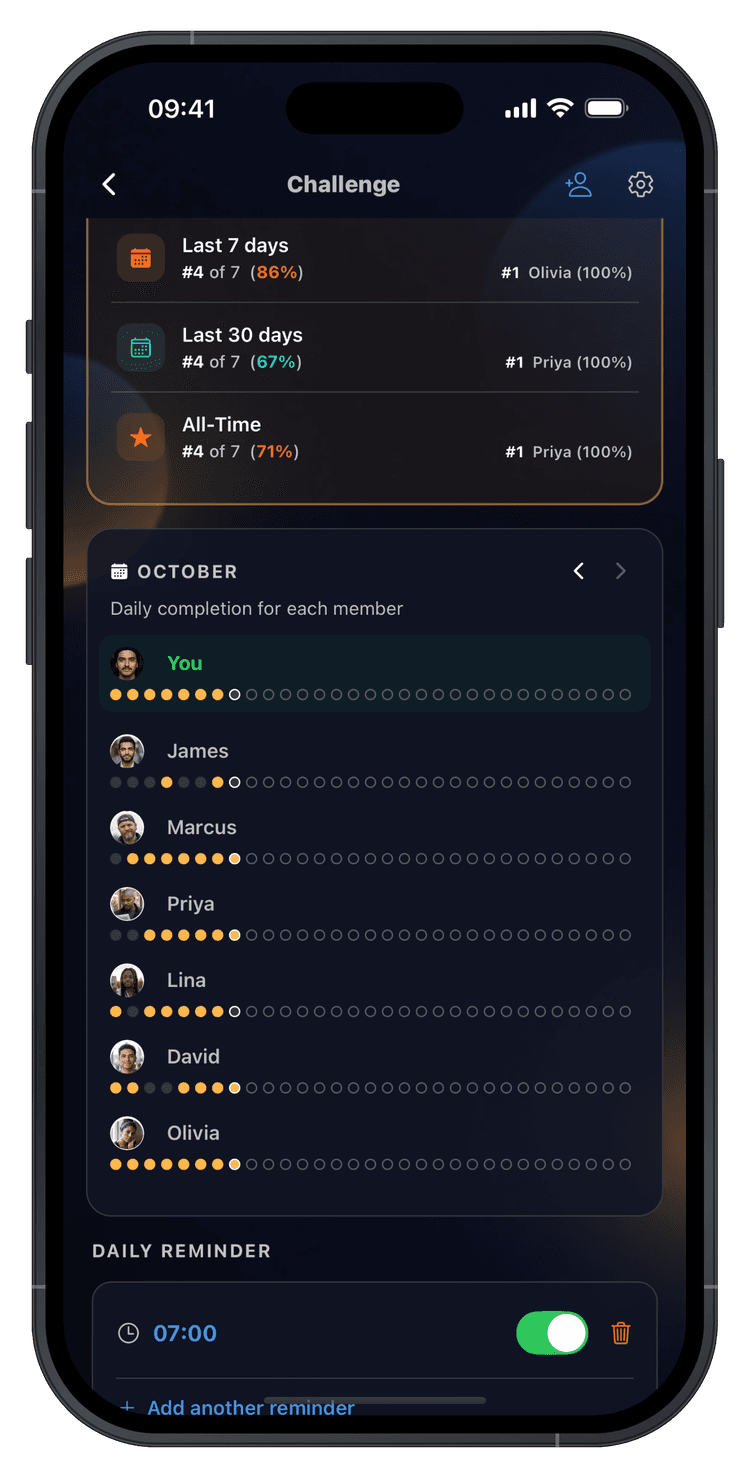
Doing it together
This is why we built Daily Pact. You start a pact with one friend or a small group, pick one small daily habit, and check in with one tap. Everyone sees who showed up, your streak grows together, and if someone goes quiet a friend can nudge them without it being awkward. It works for two people, a family or a whole church group.
Whatever you use, a shared note, a printout or an app, the principle is the same: don't quit alone.
Common questions
How many goals should I set for the new year? One or two. Every extra goal competes for the same limited willpower. Keep one goal for the whole year, then add another once the first feels automatic.
What's the difference between a new year goal and a resolution? Mostly wording. A resolution often sounds like a rule ("no more sugar"), while a goal is usually something you're working toward. Either works if it's small, specific and done daily or weekly.
When should I start my 2027 goals? Pick the goal and your partner in late December, then start on January 1. Choosing in advance means you aren't deciding on a hungover New Year's Day.
What if I'm already behind by February? Start again on the next Monday. The fresh start effect works for weeks and months too, not just for January. You don't need to wait for 2028.
What are good new years goals ideas for couples or families? Shared, low-effort ones work best: a weekly no-phones dinner, a 20-minute walk together after dinner, cooking at home four nights a week, or each person picking their own habit and checking in together.

Ready to build habits with friends?
Start your 14-day free trial. No credit card required.