
An accountabilibuddy is a friend who agrees to check whether you did the thing you said you would do, and lets you check on them in return. It's a joke word for a serious idea: most goals don't fail because you lack willpower, they fail because nobody notices when you quietly stop. An accountabilibuddy notices.
This guide covers where the word comes from, what a good accountability buddy actually does, where to find one, and the exact setup and weekly script that keeps it going past February. If you're picking a resolution for January 2027, this is the part that decides whether it survives.
Where the word "accountabilibuddy" comes from
The word was popularized by South Park, where it was played for laughs as a piece of earnest school-counselor jargon. The joke faded, but the word stuck, because it names something people actually wanted a casual word for.
Today accountabilibuddy and accountability buddy mean the same thing: a peer who holds you to a commitment, usually informally and usually for free. "Accountability partner" is the slightly more formal version. If you want the full definition and the research behind it, read what an accountability partner is. This page is the practical side: finding one and making it work.
What a good accountabilibuddy actually does
A good accountability buddy does less than you'd think. They are not a coach, a cheerleader or a drill sergeant. Their job comes down to four things:
- They know your exact commitment. Not "get healthier", but "walk 20 minutes every day in January".
- They see whether you did it. Every day, or every week, on a fixed schedule.
- They say something when you miss. Once, kindly, the same day or the next.
- They report too. It's mutual. You check on them as much as they check on you.
That last point matters more than people expect. One-way accountability turns your friend into an audience, and audiences get bored. When you both have something on the line, neither of you wants to be the first to go quiet.
Point two is where most buddy setups quietly break, because "seeing whether you did it" usually means one of you has to ask. In Daily Pact your buddy sees it without asking: you tap once when you're done, and they get a notification the moment you check in.
What they don't need: the same goal as you, more discipline than you, or any expertise. Your buddy can be learning Spanish while you're running. They just need to show up to the check-in.
Signs someone would make a good accountability buddy
- They reply to messages within a day, most days.
- You'd feel a little embarrassed telling them you skipped. That mild embarrassment is the mechanism.
- They have their own thing they've been meaning to start.
- They're not so competitive that a miss turns into a lecture.
Signs they won't
- They'll say yes to anything and follow through on little.
- They're your partner or spouse and you already argue about this habit. (Couples can do it, but pick a habit you don't fight about.)
- They're a stranger with no reason to care if you vanish. Strangers can work, but they need more structure.
Why a buddy works better than willpower
The best-known evidence on doing it with other people comes from a 1999 weight-loss study by Wing and Jeffery in the Journal of Consulting and Clinical Psychology. People who signed up with three friends were more likely to finish the program than people who signed up alone (95% versus 76%) and far more likely to keep the weight off at 10 months (66% versus 24%), especially when the program also included social support.
It's one study on one kind of goal, so don't treat it as a law of nature. But it fits what most people know from experience: a habit nobody else can see is a promise you're free to renegotiate with yourself, and you usually win that negotiation.
Where to find an accountabilibuddy
Start close and move outward. The closer the person, the higher the social cost of quitting, and the longer it lasts.
- A friend you already text. The best option for most people. The ask is small if you make it time-boxed: one habit, one month.
- A sibling, cousin or parent. Family is underrated here, especially if you live apart. A daily check-in is also an easy way to stay in touch.
- A coworker. Good for work-adjacent goals like a lunchtime walk or reading before standup. See ideas for team accountability.
- Someone from a class, club or gym. You already share a context, which makes it easier to stay consistent.
- Online communities and matched cohorts. Reddit threads, Discord servers, body-doubling sites and apps that match strangers. We cover seven of these in detail in how to find an accountability partner online.
If you'd rather use software than a group chat, our roundup of the best accountability apps compares the options for friends, partners and groups.
The ask: copy this
Most people never get an accountability buddy because "will you be my accountability partner?" sounds like a big commitment. Make it small and specific:
"I'm doing one small habit every day in January: [habit]. Want to pick one too? We'd both check in once a day so neither of us quietly quits. Just 31 days."
Time-boxed, mutual, and it names the exact failure it prevents. That's why it gets a yes.
How to set it up in 10 minutes
Agree on these five things in your first conversation. Write them down, even in a note on your phone.
| Decision | Good example |
|---|---|
| Each person's habit | "Walk 20 min" and "Read 10 pages" |
| Check-in time | By 9pm every day |
| Where you check in | One app or one chat thread |
| What a missed day means | You lose the day, nothing else |
| End date | January 31, then decide on round two |
The missed-day rule is the one people skip, and it's the one that matters. Most partnerships don't end on the day someone misses. They end three days later, when the gap has turned from an accident into a decision. Agreeing in advance that a miss costs nothing but the day stops that slide. Planned breaks are different from misses: if one of you has a trip or gets sick, Daily Pact has a PactPause, where you ask for the days off, your buddy approves, and your shared streak survives the week away. If you want it in writing, use our accountability partner agreement template.
Keep the habit small enough that you could do it on your worst day. Ten pages, not a chapter. A walk, not a 10K.
A weekly check-in script
Daily check-ins should be one tap or one word: "done". Once a week, take five minutes for a slightly longer check-in. Pick a fixed time, like Sunday evening, and run through these four questions each:
- How many days out of seven did you do it? Just the number. No excuses, no apologies.
- What made the hard day hard? One sentence. Usually it's timing, not motivation.
- What's one change for next week? Move it earlier, make it smaller, put the book on the pillow.
- Anything you need from me? A morning nudge, a reminder before a trip, or nothing.
Then stop. The point of the weekly check-in is to fix the system, not to judge the person. If you find yourself giving a speech, cut it.
When your buddy goes quiet
It will happen at some point. Send one direct, friendly message: "Haven't seen a check-in since Tuesday. Want to restart tomorrow, or shrink the habit?" A nudge in the app does the same job with less awkwardness: it lands on their lock screen with the habit's name, and it reads as "I'm still here" rather than "you failed".
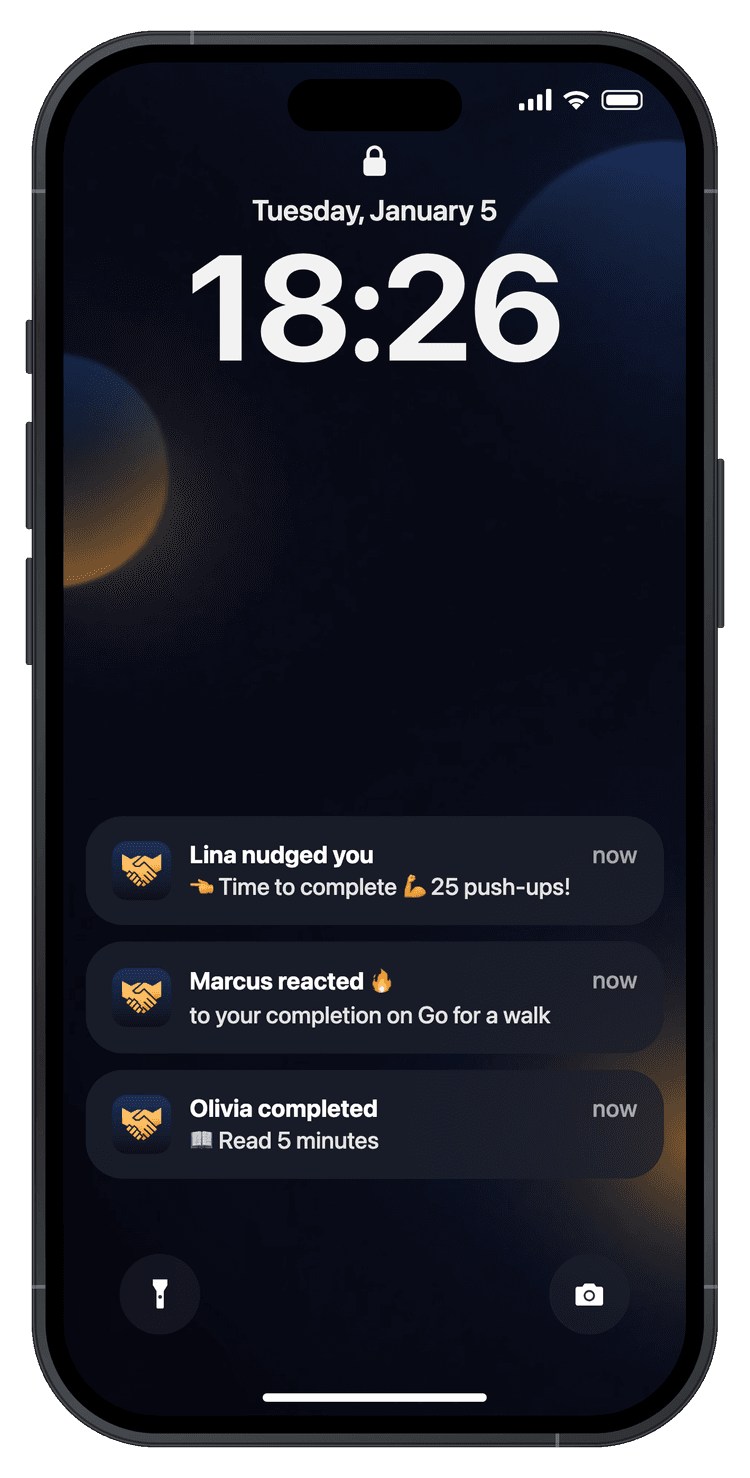
If they stay quiet, don't chase. Add a third person or switch to a small group. A group survives one person disappearing; a pair doesn't. Our guide to starting an accountability group covers that step.
An ADHD accountability buddy
People with ADHD often describe an accountability buddy as one of the most useful tools they have, largely because it turns an internal intention into an external commitment. A few adjustments help:
- Body doubling. Instead of only reporting afterwards, do the task at the same time, in person or on a video call. Many people find starting is the hardest part, and company makes starting easier.
- Shorter loops. Daily check-ins beat weekly ones. A week is a long time to hold a thread.
- Reminders outside your head. Use an app notification or a recurring alarm so the check-in doesn't depend on remembering. Daily Pact lets you set several reminders a day for one habit, and on iPhone a Live Activity keeps today's habits on your Lock Screen, so the commitment is in front of you every time you pick up the phone.
- No shame on misses. Agree that a miss is information, not failure. Shame is what makes people disappear.
This is general advice, not treatment. If ADHD is affecting your daily life, talk to your doctor or a qualified clinician.
Doing it with an app instead of a chat
A group chat works for about a week, then the check-ins get vaguer and nobody wants to be the one asking "did you do it?". That exact problem is why I built Daily Pact. You start a pact with one friend or a small group, pick one daily habit, and check in with one tap. Everyone sees who showed up, streaks grow together, and the app sends the reminder so your buddy doesn't have to.
For January 2027 we're running the January Pact: one small habit, one friend, every day from January 1 to 31. Don't quit alone. If you're still choosing the habit, start with our guide to goals for the new year.
Frequently asked questions
What does accountabilibuddy mean? An accountabilibuddy is a friend who holds you to a commitment and lets you do the same for them. It's a playful blend of "accountability" and "buddy", popularized by South Park, and it means the same thing as an accountability buddy or accountability partner.
Is an accountability buddy the same as an accountability partner? In practice, yes. "Buddy" sounds more casual and "partner" more formal, but both describe a peer who checks in on your progress on a fixed schedule.
How often should accountability buddies check in? Daily for a daily habit, with a quick one-word or one-tap check-in, plus a five-minute review once a week. Weekly-only check-ins let too many missed days pass unnoticed.
Can my accountabilibuddy have a different goal from mine? Yes. Different goals work fine. What matters is that you both report on the same schedule.
What if I don't have anyone to ask? Try a matched cohort, a Discord server or a body-doubling site. Strangers drop out more easily than friends, so pick a format with a few people in it rather than just one.

Ready to build habits with friends?
Start your 14-day free trial. No credit card required.