Most January workout challenges fail in week two, and not because people are lazy. They start with six hard sessions a week, get sore, miss a day, and then quietly stop. A good January workout challenge starts smaller than you think it should, gets a little harder each week, and has a friend on the other end checking you showed up.
Below are two 31-day plans for January 2027 (beginner and intermediate), a shorter 21-day workout challenge for people who want to start on a Monday, and the rules that keep a January fitness challenge going once the motivation fades.
Before you start
- Check with your doctor first if you have a heart condition, are pregnant, are recovering from an injury, or haven't exercised in a long time. These plans are general guidance, not medical advice.
- The target to aim for over time: the CDC's physical activity guidelines for adults are at least 150 minutes of moderate activity a week, plus muscle-strengthening activity on two or more days. Both plans below build toward that.
- No equipment needed. A mat or towel, a backpack with a few books in it, and a sturdy chair or wall.
- January 2027 starts on a Friday. The plans use the real dates, so you and your friend can be on the same day.
The two workouts used in the plans
Both plans rotate between two short strength circuits. Do each move in order, rest a minute, then repeat for the number of rounds the plan says.
Workout A
- 10 squats (to a chair if you need to)
- 8 push-ups (on your knees or with hands on a table for an easier version)
- 10 glute bridges
- 20-second plank
Workout B
- 8 reverse lunges per leg
- 10 backpack rows (bend forward, pull a loaded backpack to your ribs)
- 10 dead bugs per side
- 20-second side plank per side
Walks are at a brisk pace, the kind where you can talk but wouldn't want to sing. Mobility means 10 minutes of gentle stretching: hips, hamstrings, shoulders, back.
January workout challenge for beginners: 31 days
This is the day-by-day plan. Rounds and walk times creep up each week. If a day goes wrong, do a 10-minute walk and count it. The habit is showing up.
| Date | Day | Workout |
|---|---|---|
| Jan 1 | Fri | Walk 15 min |
| Jan 2 | Sat | Workout A, 2 rounds |
| Jan 3 | Sun | Mobility 10 min |
| Jan 4 | Mon | Workout B, 2 rounds |
| Jan 5 | Tue | Walk 20 min |
| Jan 6 | Wed | Workout A, 2 rounds |
| Jan 7 | Thu | Mobility 10 min |
| Jan 8 | Fri | Walk 20 min (Quitter's Day: keep it easy, just show up) |
| Jan 9 | Sat | Workout B, 2 rounds |
| Jan 10 | Sun | Rest |
| Jan 11 | Mon | Workout A, 3 rounds |
| Jan 12 | Tue | Walk 25 min |
| Jan 13 | Wed | Workout B, 3 rounds |
| Jan 14 | Thu | Mobility 10 min |
| Jan 15 | Fri | Walk 25 min |
| Jan 16 | Sat | Workout A, 3 rounds |
| Jan 17 | Sun | Rest |
| Jan 18 | Mon | Workout B, 3 rounds |
| Jan 19 | Tue | Walk 30 min |
| Jan 20 | Wed | Workout A, 3 rounds, plank 30 sec |
| Jan 21 | Thu | Mobility 10 min |
| Jan 22 | Fri | Walk 30 min |
| Jan 23 | Sat | Workout B, 3 rounds, side plank 30 sec |
| Jan 24 | Sun | Rest |
| Jan 25 | Mon | Workout A, 3 rounds, plank 30 sec |
| Jan 26 | Tue | Walk 30 min |
| Jan 27 | Wed | Workout B, 3 rounds, side plank 30 sec |
| Jan 28 | Thu | Mobility 10 min |
| Jan 29 | Fri | Walk 35 min |
| Jan 30 | Sat | Rest |
| Jan 31 | Sun | Test day: Workout A, 3 rounds, then compare with Jan 2 |
By the last week you are doing two strength sessions, a mobility session and about 65 minutes of brisk walking. Not the full guideline yet, but a real base, built on a habit instead of a burst.
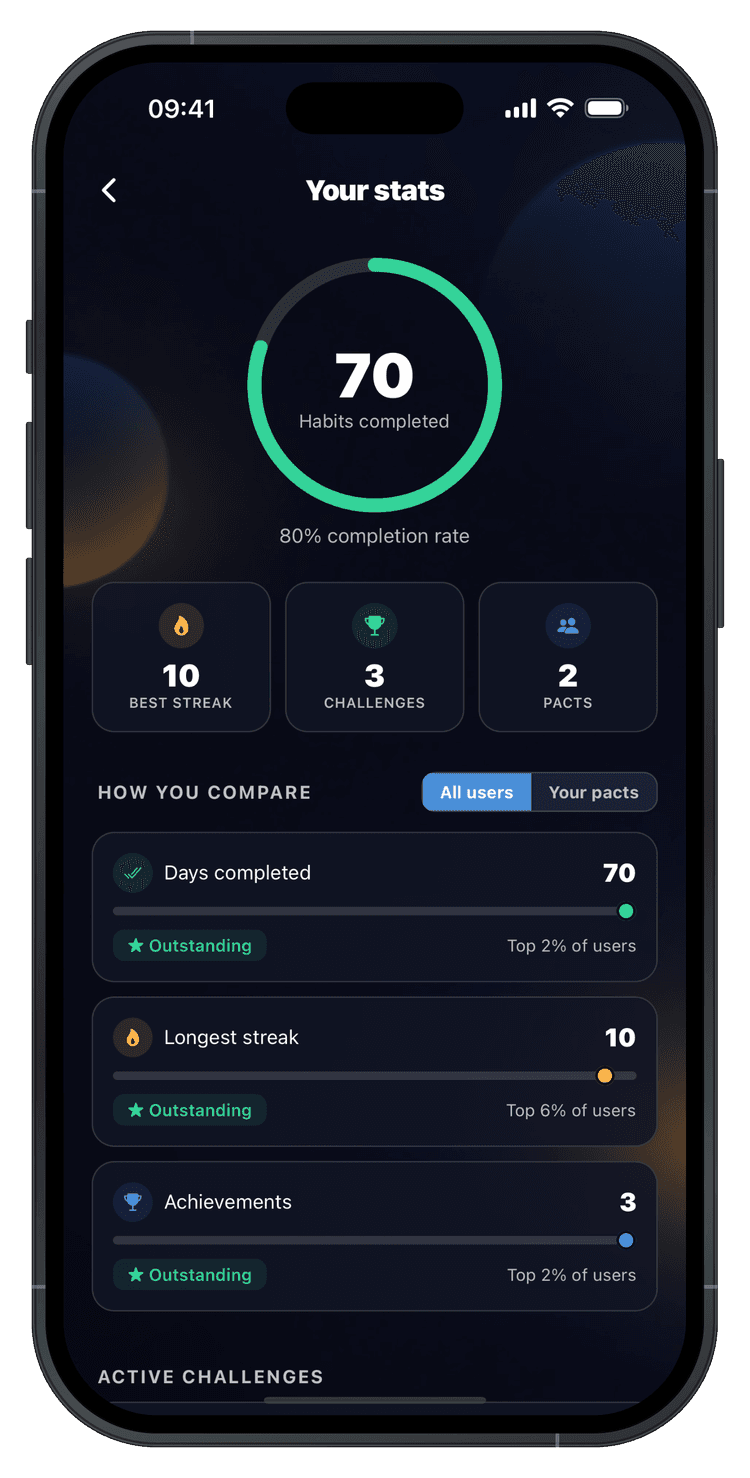
The January 31 test day is more fun with the month written down. If you track the plan in Daily Pact, you'll both have your days done, completion rate and best streak for January to put next to the result.
January fitness challenge: intermediate plan
For people who already exercise a bit and want January to be a step up. Five days of training a week, two rest or mobility days, and a clear progression. You choose which days, as long as you and your friend agree on the weekly count. In Daily Pact this works as a weekly challenge (five times a week), so a Tuesday off doesn't count as a miss as long as you both hit five by Sunday.
| Week | Strength (Workout A or B) | Cardio | Mobility |
|---|---|---|---|
| Jan 1 to 3 | 1 session, 3 rounds | 1 session, 20 min run/walk or bike | 1 session |
| Jan 4 to 10 | 3 sessions, 3 rounds | 2 sessions, 25 min | 1 session |
| Jan 11 to 17 | 3 sessions, 4 rounds | 2 sessions, 30 min | 1 session |
| Jan 18 to 24 | 3 sessions, 4 rounds, harder variations | 2 sessions, 30 min with 5 x 1 min faster | 1 session |
| Jan 25 to 31 | 3 sessions, 4 rounds | 2 sessions, 35 min | 1 session |
Harder variations for week four: full push-ups instead of knee push-ups, single-leg glute bridges, a 45-second plank, jump squats if your knees are happy with them.
Cardio can be running, cycling, swimming, a rowing machine or a fast hill walk. Pick what you'll actually do in January weather.
If you'd rather swap these for a gym routine, keep the structure: three strength days, two cardio days, one mobility day, one full rest day.
21 day workout challenge (Jan 4 to 24)
Prefer not to start on a holiday? A 21-day workout challenge from Monday January 4 to Sunday January 24 gives you exactly three full weeks. Follow the beginner table for those dates, or the intermediate weeks two to four.
Three weeks is a good test. It won't make exercise automatic (more on that below), but it's long enough to know whether the time of day and the type of workout actually fit your life. For more three-week ideas beyond fitness, see our 21-day challenge ideas.
How to do it with a friend
Doing a January workout challenge with someone else changes the question from "do I feel like it?" to "do I want to be the one who didn't?". That's not a small thing. In a 1999 weight-loss study by Wing and Jeffery, 95% of participants recruited with friends completed the program, compared with 76% of those who joined alone.
A few ways to make it work:
- Pick the same plan and the same dates. Then "day 12" means the same thing to both of you.
- Check in every day, even rest days. Rest is part of the plan. Logging it keeps the daily rhythm. Call the challenge "Today's plan done" rather than "Workout", and a rest day check-in keeps the streak going for both of you.
- Share one detail, not a full report. "Three rounds, plank felt better" is plenty.
- Agree what a missed day means. It costs you that day, nothing else. Pick up the next workout in the table, don't try to double up.
- Train together once a week if you can. A Saturday walk or session in person makes the other six days feel more shared.
You don't need any special app for this, but a shared check-in helps. With Daily Pact you start a pact with your friend, both tap once when the day's workout is done, and you see each other's streaks grow together. If your friend hasn't checked in by 8pm, you can nudge them. For more on choosing who to ask, read our guide to finding an accountabilibuddy.
Doing it with a bigger crowd? Our fitness challenges with friends page has ideas that work for teams and clubs.
Getting through week two
Week two is the danger zone for every January fitness challenge. The second Friday of January, which Strava named Quitter's Day, falls on January 8 in 2027. That's why the beginner plan has an easy walk that day.
Three things help:
- Make the bad-day version tiny. If you're exhausted, do one round, or a 10-minute walk. It still counts as showing up.
- Fix a time. "After I drop the kids off" or "before dinner" works much better than "sometime today".
- Keep the streak shared. Missing a day is easier when it's only your secret.
After January
The research on habits is honest about timelines. Lally and colleagues (2010) found it took a median of 66 days for a daily behavior to feel automatic, with a range of 18 to 254 days. They also found that missing one day didn't meaningfully hurt the process. So January is the start, not the finish. Read more in how long it takes to form a habit.
On February 1, keep the structure and repeat the last week of whichever plan you did, or step up from beginner to intermediate. For the bigger picture of your goals in 2027, see our goals for the new year hub, or browse more January challenge ideas.
FAQ
What is a good January workout challenge for beginners? Something you can do at home in 20 to 30 minutes, with walks and two short strength circuits, building up a little each week. The beginner plan above starts with a 15-minute walk on January 1 and builds to about 35 minutes by the end of the month.
How many days a week should I work out in January? For beginners, three to four active days plus mobility and rest is plenty. For intermediate, five training days with one mobility and one rest day. More isn't better if it makes you quit in week two.
Is a 21 day workout challenge enough to build a habit? It's a good start, but research suggests most habits take longer. Lally et al. (2010) found a median of 66 days. Use 21 days to find a routine that fits, then keep going.
What if I miss a day? Skip it and pick up the next workout in the table. Don't double up. Missing one day doesn't undo your progress.
Can I do this January fitness challenge with a group? Yes. Everyone follows the same plan and checks in daily. It works for a group of friends, a team at work or a running club.

Ready to build habits with friends?
Start your 14-day free trial. No credit card required.