
A year is too long to plan in one go. A month is about right. These monthly goals ideas give you one small goal for each month of 2027, chosen to fit the season, plus a simple review ritual for the last Sunday of each month so the goals connect instead of resetting every four weeks.
The idea is simple: twelve small goals you actually finish beat one big resolution you drop in February. Each goal below has a clear finish line, a "minimum version" for bad weeks, and a reason it fits that particular month.
If you want shorter, daily challenge formats instead, see our monthly challenge ideas. This page is about goals: what you want to be true by the end of each month, and how to review it.
How to set a good monthly goal
A good monthly goal has three parts:
- An outcome you can check on the last day. "Read two books" or "walk 20 minutes on 25 days", not "be healthier".
- A daily or weekly action that gets you there. The goal is the destination. The action is what you do on a Tuesday.
- A minimum version. What counts on your worst day. Ten pages instead of thirty, a 10-minute walk instead of 30.
Keep it to one main goal per month. You can add a second, smaller one if the first is going well by the 10th. Stacking five goals on January 1 is the most common way to finish none of them.
January goals ideas
January deserves its own section, because it's when most people set goals and when most people drop them. Strava's activity data points to the second Friday of January as the day people are most likely to quit, which is known as Quitter's Day. In 2027 that's January 8. Good January goals are small enough to survive it.
Here are January goals ideas that work:
- Walk 20 minutes every day. The minimum version is 10 minutes around the block.
- Read 10 pages a night. That's roughly one to two books by January 31.
- No phone for the first 30 minutes after waking. Put the charger in another room.
- Drink a glass of water before your first coffee. Tiny, and it builds a morning cue.
- Write one line in a journal before bed. One line, not one page.
- Cook dinner at home five nights a week. Track it on a calendar.
- Go to bed by a set time on weeknights. Pick a realistic time, not your ideal one.
- Stretch for five minutes after you get up. Easy to keep and easy to grow.
- A no-spend week, once in January, after the holiday bills land.
- Text one friend a day. Simple, and January is a lonely month for a lot of people.
- Try Dry January or cut back on alcohol. For guidance and support, use Alcohol Change UK, the charity behind Dry January, and talk to your doctor if you drink heavily.
- Learn 10 words a day in a new language. An app session counts.
Whichever you pick, do it with someone. The hardest part of January isn't day one, it's the second week, and a friend who sees whether you showed up gets you through it. That's what our January Pact is for: one small habit, one friend, every day from January 1 to 31. In Daily Pact you'd set it up as a pact with your friend: you each tap once a day, and you can both see who showed up on the 8th. See the January challenge for the format, and the hub on goals for the new year for how to choose.
12 months of small goals for 2027
One goal per month, chosen to suit the season.
| Month | Goal | Minimum version |
|---|---|---|
| January | One daily habit, all 31 days | 10 minutes of it |
| February | Sleep: a consistent bedtime | Same time on weeknights |
| March | Move outside daily as light returns | A 10-minute walk |
| April | Clear one area of your home | One drawer a day |
| May | Eat a vegetable with every lunch | One portion a day |
| June | Hit a weekly step target | Compare weekly, not daily |
| July | Finish two books | 10 pages a day |
| August | Save a set amount | One no-spend day a week |
| September | Learn one new skill | 15 minutes a day |
| October | Fix your mornings | First 30 minutes phone-free |
| November | Reconnect: one person a week | One message a day |
| December | Reflect and choose next year's goals | One journal line a day |
A few notes on each:
January: one daily habit. Everyone else is starting something too, so the social cost is zero. Pick the one habit that would make the biggest difference if it stuck, and do only that.
February: sleep. Short, dark, low-energy. A consistent bedtime is the goal that makes every other goal easier. Shift it by 15 minutes a week rather than all at once.
March: move outside. Light comes back in March in much of the northern hemisphere. Use it. A daily walk is the easiest goal on this list to keep and one of the most felt.
April: clear one area. Spring cleaning, but scoped. One room, one closet or the garage, not the whole house.
May: one food change. Pick a single addition, not a restriction. Adding a vegetable to lunch is easier to keep than cutting something out.
June: steps. Long days make step goals easy. If you're doing it with a friend, compare weekly totals, since daily comparisons get discouraging when one of you has a desk job. Our step challenge with friends has formats.
July: read. Holidays make July good for reading and bad for anything that needs a gym or a routine.
August: money. After summer spending, a savings goal or a few no-spend days a week resets the budget before autumn.
September: learn. Back-to-school energy works for adults too. Language, instrument, cooking, coding. Fifteen minutes a day.
October: mornings. Darker mornings make routines slip. Protect the first 30 minutes: no phone, one useful thing.
November: people. One message, call or coffee a week with someone you've lost touch with. It also sets you up with a partner for next January.
December: reflect. Don't start a new hard goal during the holidays. Write one line a day about what worked this year, then pick your January goal and your partner by December 31.
The monthly review ritual (15 minutes)
The review is what turns twelve separate goals into a year of progress. Do it on the last Sunday of each month. Put it in your calendar now for all twelve months.
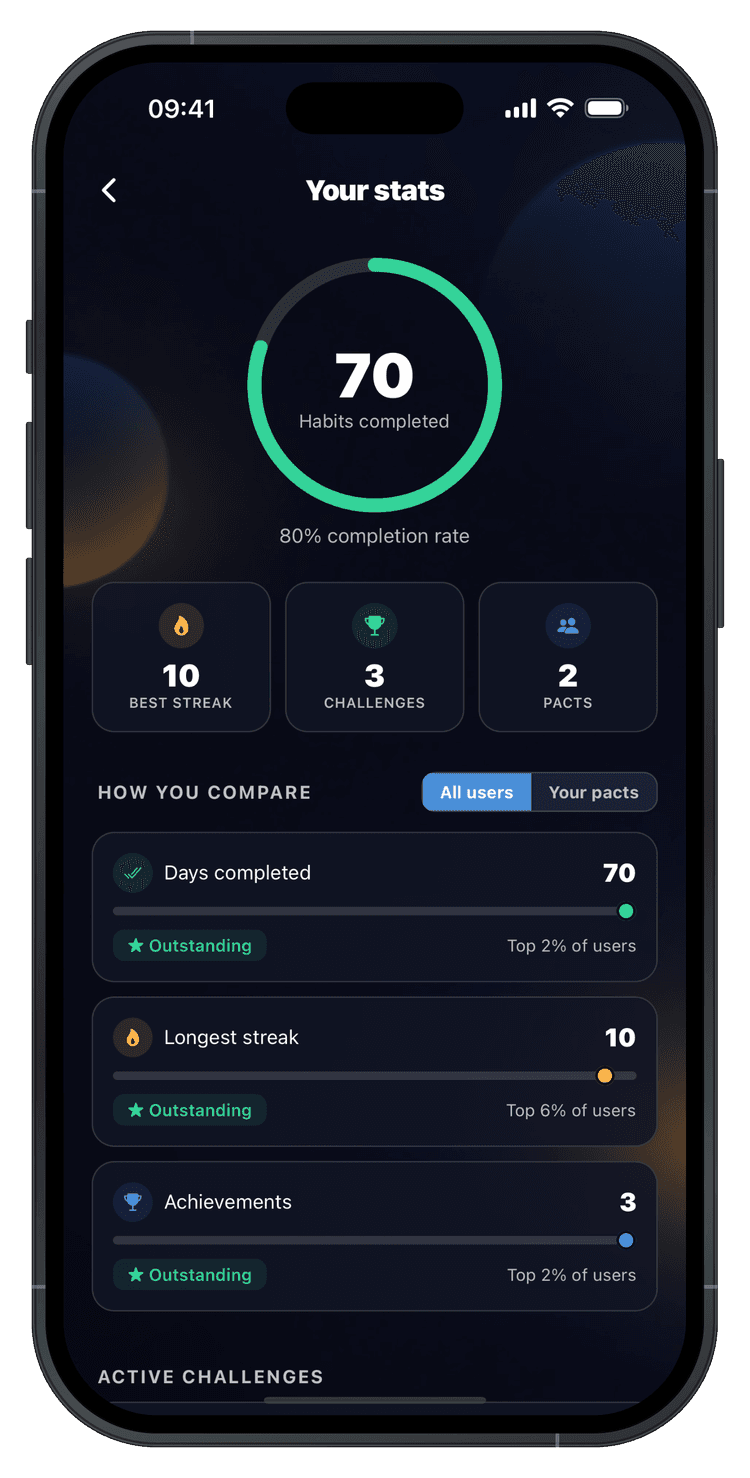
1. Score the month (2 minutes). How many days or weeks did you do the action? Write the number down. No commentary. If you've been checking in on an app, this number already exists: Daily Pact's monthly view shows your completion rate and streak for the month, so the review starts with a fact instead of a guess.
2. Name what worked (3 minutes). What made the good days good? Usually it's a time, a cue or a person. "I walked when I did it right after lunch."
3. Name what got in the way (3 minutes). One or two things. Be specific: "Thursdays, because of late meetings", not "I got busy".
4. Decide: keep, grow or swap (3 minutes). If the habit is going well, keep it running at the minimum level and add next month's goal. If it's shaky, keep it as the goal for another month. If it was the wrong goal, swap it.
5. Set next month's goal (4 minutes). Outcome, daily action, minimum version. Tell one person.
That "keep, grow or swap" step is the important one. Most habits take longer than a month to become automatic. Research by Phillippa Lally and colleagues found a median of 66 days for a daily behavior, with a wide range between people. Read more in how long it takes to form a habit. So a January habit you keep at minimum level through February and March is far more likely to last than one you abandon on February 1 for something new.
Doing the review with a friend
The review works better out loud. Swap scores with a friend or your accountability partner, five minutes each, on the same Sunday every month. If you want the rules written down, our accountability partner agreement template has a weekly review built in, and you can stretch it to monthly.
Tracking monthly goals
You need somewhere to see the score. Three options:
- Paper. A printable habit tracker on the fridge, one per month. Simple and very visible.
- A calendar. Mark each day you did it. The chain of marks is the motivation.
- An app with a friend. In Daily Pact you start a pact with one friend or a small group, pick the month's daily habit (or a weekly one, for goals like a no-spend day a week), and check in with one tap. When a new month brings a new goal, start it as a new pact and keep last month's running alongside at its minimum version.
If you're choosing an app for this, our comparison of accountability apps covers the options.
Frequently asked questions
What are good monthly goals? Small, specific goals with a clear finish line and a daily or weekly action, such as "walk 20 minutes on 25 days" or "read two books". One main goal per month works better than several.
What are good January goals? A single daily habit you can keep through the second week of January: a daily walk, 10 pages of reading, a phone-free first 30 minutes, or a consistent bedtime. Do it with a friend to get past Quitter's Day on January 8.
How many goals should I set per month? One main goal. Add a second small one only if the first is going well by mid-month.
Should I drop last month's habit when I start a new goal? No. Keep it running at its minimum version. Most habits need more than a month to stick, so stacking the year one habit at a time works better than resetting each month.
What's the difference between monthly goals and monthly challenges? A challenge is a fixed daily task for the month. A goal is an outcome you check at the end of the month, with a review that feeds the next one. See our monthly challenge ideas for the challenge version.

Ready to build habits with friends?
Start your 14-day free trial. No credit card required.