If you want to know how to keep New Year's resolutions, the research is more encouraging than the jokes suggest. Resolutions work better than most people think. They just fail in predictable ways, at predictable times, and most of those failures have known fixes.
This page pulls together the studies that hold up: how many resolutions last, why they fail, and the five things with the best evidence behind them. Every number below has its source named, so you can check it.
The short version
- People who make resolutions do much better than people who want to change but don't commit. (Norcross et al., 2002)
- Resolutions fade fastest in the first weeks. Strava's data puts the drop-off around the second Friday of January, which it calls Quitter's Day.
- Habits take longer than the myth says: a median of 66 days, not 21. (Lally et al., 2010)
- One missed day doesn't undo a habit. Quitting after the missed day does.
- Doing it with a friend is the single biggest lever. In one study, 66% of people recruited with friends kept their weight off at 10 months, against 24% who came alone. (Wing & Jeffery, 1999)
New Year's resolution statistics that hold up
You'll see a lot of numbers about resolutions online. Many can't be traced to a study. These can.
| Finding | Source |
|---|---|
| 77% of resolvers kept their resolution for one week; 19% were still going after two years | Norcross & Vangarelli, 1989 |
| After six months, 46% of people who made a resolution were succeeding, compared with 4% of people who wanted to change but didn't make one | Norcross, Mrykalo & Blagys, 2002 |
| Approach goals ("start running") were kept more often than avoidance goals ("stop eating sweets"): 58.9% versus 47.1% | Oscarsson et al., 2020 |
| Forming a new daily habit took a median of 66 days, ranging from 18 to 254 days | Lally et al., 2010 |
| Missing one day did not meaningfully affect habit formation | Lally et al., 2010 |
| If-then plans ("implementation intentions") had a medium-to-large effect on reaching goals across 94 studies | Gollwitzer & Sheeran, 2006 |
| People recruited with friends (plus social support): 95% finished treatment and 66% maintained weight loss at 10 months, versus 76% and 24% recruited alone | Wing & Jeffery, 1999 |
| People are more likely to start on goals after temporal landmarks such as New Year, a birthday or a Monday (the "fresh start effect") | Dai, Milkman & Riis, 2014 |
A note on one number you'll see everywhere: the claim that only 8% of people achieve their resolutions. It's repeated in thousands of articles, but it's hard to trace to a published, peer-reviewed study, so we've left it out of the table.
Why do New Year's resolutions fail?
Not because people are lazy. The research points to a few repeatable reasons.
The resolution is too big. "Get fit" can't be done on a Tuesday, so you never quite know whether you did it. Vague goals lose to busy days.
It's framed as stopping, not starting. Oscarsson's 2020 study found approach goals did better than avoidance goals. "Eat fruit after dinner" gives you something to do. "No more snacking" only gives you something to fail at.
There's no plan for when. "I'll exercise more" doesn't say when, where or after what. The decision has to be made again every day, and every day it's easier to postpone.
The timeline is wrong. If you expect a habit in 21 days and it still feels like effort on day 30, it's tempting to conclude it isn't working. Lally's median of 66 days says it's just not done yet.
One miss turns into a story. You miss a day, decide you've "broken" the resolution, and stop. The miss didn't end it. The story did.
Nobody notices. A private resolution can be renegotiated with yourself at no cost. When no one sees you stop, stopping is easy.
How to keep New Year's resolutions: 5 things that work
1. Make it small and specific
Shrink the resolution until you could do it on your worst day: tired, ill, late home. "Run 5K three times a week" becomes "put on running shoes and go outside." "Read more" becomes "read 10 pages before bed."
Make it binary, so the answer at bedtime is yes or no. And where you can, phrase it as something to start doing rather than something to stop. That's the direction Oscarsson's data points.
2. Decide exactly when and where
Use an if-then plan: "After [something you already do], I will [the new habit]." For example: "After I pour my morning coffee, I'll do 10 push-ups." Or: "When I get into bed, I'll read 10 pages."
Gollwitzer and Sheeran's 2006 meta-analysis of 94 studies found that this kind of planning had a medium-to-large effect on goal attainment. It works because the decision is made once, in advance, instead of every day in the moment.
3. Do it with someone
This is the factor with the biggest effect in the research, and the one most people skip.
Wing and Jeffery (1999) recruited people for a weight-loss programme either alone or with friends. Those who came with friends, and got social support during the programme, were more likely to finish (95% versus 76%) and far more likely to keep the weight off: 66% maintained their weight loss at 10 months, against 24% of those who came alone.
Your partner doesn't need the same resolution. They need to check in, and to notice if you don't. That's the whole job of an accountabilibuddy. If you want more on how this works, see our guide to what an accountability partner is.
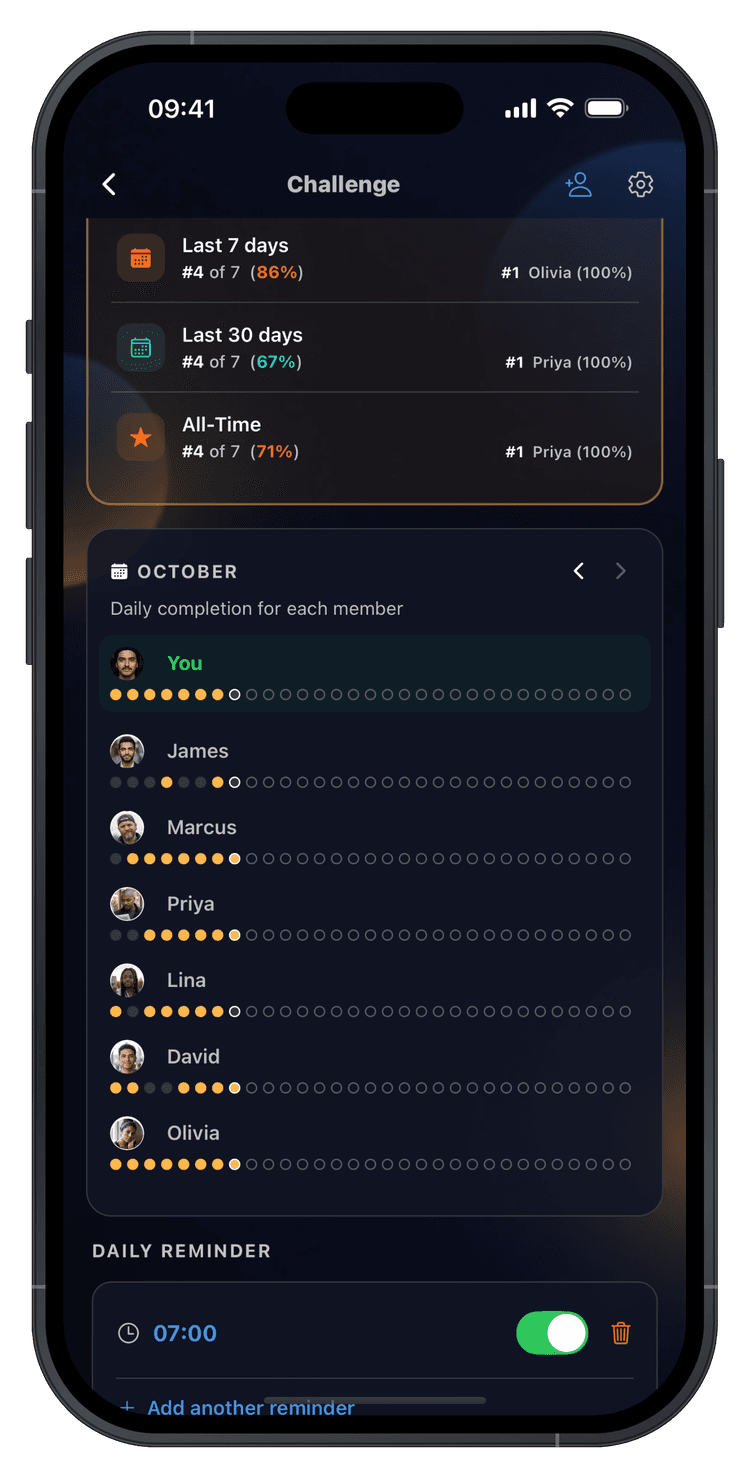
The research describes the "notice" part with a phrase: social support. In practice it often means one person seeing, without having to ask, whether you did it today. That's the screen we built Daily Pact around: everyone in the pact, their streak, and who's shown up.
4. Plan for the dip, especially Quitter's Day
Strava, looking at activity data from its users, found that motivation most often drops around the second Friday of January. It named the day Quitter's Day. In 2027, that's Friday, January 8.
Knowing the date is useful. Put it in your calendar, tell your partner, and agree to check in on purpose that day. Our page on Quitter's Day covers that week in more detail. A daily reminder at the time you planned helps too: in Daily Pact you can set several per habit, so an evening one catches the days the morning one didn't.
The fresh start effect helps here too. Dai, Milkman and Riis (2014) found people are more likely to start on goals after "temporal landmarks." January 1 is the biggest one, but every Monday and every first of the month is a smaller one. If you slip, you don't have to wait a year.
5. Never miss twice
Lally's study found that missing a single day didn't meaningfully affect how quickly a habit formed. So treat one miss as normal, and set one rule: never miss twice in a row.
Agree on this with your partner before it happens. It turns the most common quitting moment into a non-event. A pause for illness or travel is fine too, as long as you both agree on when it ends.
A simple plan for January 2027
Put the five together and you get something like this:
- Before December 31: pick one small habit and one friend. Write your if-then plan.
- January 1 to 31: check in with each other every day. A month is long enough to matter and short enough to see the end. We call this the January Pact, and our January challenge has ideas to start from.
- January 8: Quitter's Day. Check in on purpose.
- February 1: keep going. You're around day 31 of a habit that probably needs about 66. Our guide on how long it takes to form a habit explains what to expect next.
If you're still choosing what to do, start with our goals for the new year or New Year's resolution ideas. A printed habit tracker on the fridge works well for a pair or a household.
Where Daily Pact fits
We built Daily Pact around point three, and it quietly helps with the others. The habit is one binary check-in a day (point one). Reminders land at the time you planned (point two). Everyone sees who showed up, and nudging a friend who's gone quiet takes one tap instead of an awkward message (points three and four). PactPause covers the sick days without breaking anyone's streak (point five). It doesn't replace the five steps. It just makes them easier to keep doing together.
Common questions
What percentage of New Year's resolutions fail? It depends on when you measure. Norcross and Vangarelli (1989) found 77% of resolvers were still going after one week and 19% after two years. Later work by Norcross and colleagues (2002) found 46% of resolvers were succeeding at six months. The often-quoted "only 8% succeed" figure is hard to trace to a published study.
When do most people give up on their resolutions? In the first few weeks of January. Strava's data points to the second Friday of January, which it calls Quitter's Day. In 2027 that's January 8.
How long does it take to make a resolution a habit? In Lally et al. (2010), a median of 66 days, with a range of 18 to 254 days depending on the person and the habit. The 21-day figure isn't supported by that research.
Is it better to keep a resolution private or tell people? Tell one person who will check in with you. The strongest evidence is for social support, like the friend groups in Wing and Jeffery's study, rather than for announcing it widely.
I already broke my resolution. Should I wait until next year? No. Start again on the next Monday or the first of the month. One miss doesn't undo progress, and the fresh start effect works on smaller landmarks too.

Ready to build habits with friends?
Start your 14-day free trial. No credit card required.