
How long does it take to form a habit? The short answer: usually about two months, and often much longer. The best-known study found a median of 66 days for a daily behavior to become automatic, with individuals ranging from 18 to 254 days. The popular "21 days to form a habit" figure isn't from habit research at all.
That gap matters, because people who expect a habit to feel easy after three weeks tend to read week four as failure. Here's where the 21-day idea came from, what the research actually says, what speeds habit formation up, and what all of it means if you're planning a 31-day challenge in January 2027.
Where "21 days to form a habit" came from
The 21-day number traces back to Maxwell Maltz, a plastic surgeon who wrote the 1960 self-help bestseller Psycho-Cybernetics. Maltz observed that his patients seemed to take a minimum of about 21 days to get used to a change, such as a new face in the mirror or the absence of an amputated limb. He extended the observation to other kinds of change, including self-image.
Notice two things. First, it was an observation from clinical practice, not a study of habits. Second, Maltz said "a minimum of about 21 days". Over decades of retelling, "a minimum of about" disappeared and the number became a rule: 21 days to form a habit.
It survived because it's a satisfying number. Three weeks feels achievable. That's a fine reason to run a 21-day challenge, but it's not a reason to expect a habit to be locked in by day 22.
What the research says: 66 days, with a huge range
The study most people cite is by Phillippa Lally and colleagues at University College London, published in the European Journal of Social Psychology in 2010. They asked 96 volunteers to pick one new eating, drinking or exercise behavior, do it once a day in the same situation (for example, "drink a bottle of water after breakfast"), and report each day for 12 weeks how automatic it felt.
What they found:
- The median was 66 days for the behavior to reach its peak level of automaticity. That's where the "66 days to form a habit" figure comes from.
- The range was enormous: 18 to 254 days. Some people got there in under three weeks. For others, the curve was still rising at the end, and the researchers estimated it would take most of a year. (The longer estimates are projections, since the study itself lasted 12 weeks.)
- Simpler behaviors got there faster. Drinking a glass of water tended to become automatic sooner than doing 50 sit-ups.
- Missing one day didn't derail it. A single missed opportunity did not materially affect how automatic the habit became over time. This is one of the most useful findings in the paper and the least quoted.
The 2024 systematic review
A newer systematic review and meta-analysis by Ben Singh and colleagues at the University of South Australia, published in the journal Healthcare in 2024, pooled 20 studies on health behavior habits. It found median times of roughly 59 to 66 days, with individual results ranging from about 4 to 335 days. In other words: the more studies you look at, the more "about two months, give or take a lot" holds up, and the less any single number does.
So what's the honest answer?
| Claim | What it really means |
|---|---|
| 21 days | A loose clinical observation from 1960, not a habit study |
| 66 days | Median in one well-known study; half took longer |
| 18 to 254 days | The real spread between people in that study |
| About 2 months | A reasonable expectation for a simple daily habit |
If you remember one thing: habit formation is a curve, not a finish line. Each repetition in the same context makes the next one a little easier. There's no day when it flips from hard to automatic.
What speeds habit formation up
You can't pick your number, but you can move it. Across the research on habits, a few factors come up again and again:
1. Keep the habit small. Lally's participants with simple behaviors got there faster. "Do 5 push-ups" becomes automatic sooner than "do a full workout". Start small and grow the habit once it runs on its own.
2. Use the same cue every time. Habits form when an action gets linked to a context. "After I pour my morning coffee, I write one line in my journal" works better than "journal sometime in the morning". Psychologists call this an implementation intention: a plan in the form "when X, I will do Y". A 2006 meta-analysis by Gollwitzer and Sheeran found these if-then plans had a meaningful effect on whether people followed through on goals.
3. Do it daily if you can. Habits are built by repetition in a stable context. Daily is easier to automate than "three times a week", because there's no decision about which days.
4. Make it at least a little enjoyable. Behaviors you enjoy get repeated more. Pair the habit with something you like: a podcast on the walk, a nice pen for the journal.
5. Don't treat a miss as failure. The Lally finding is worth repeating: one missed day didn't derail the process. What derails it is the second and third missed day, when "I skipped once" turns into "I've stopped". Decide in advance that a miss costs you the day and nothing else.
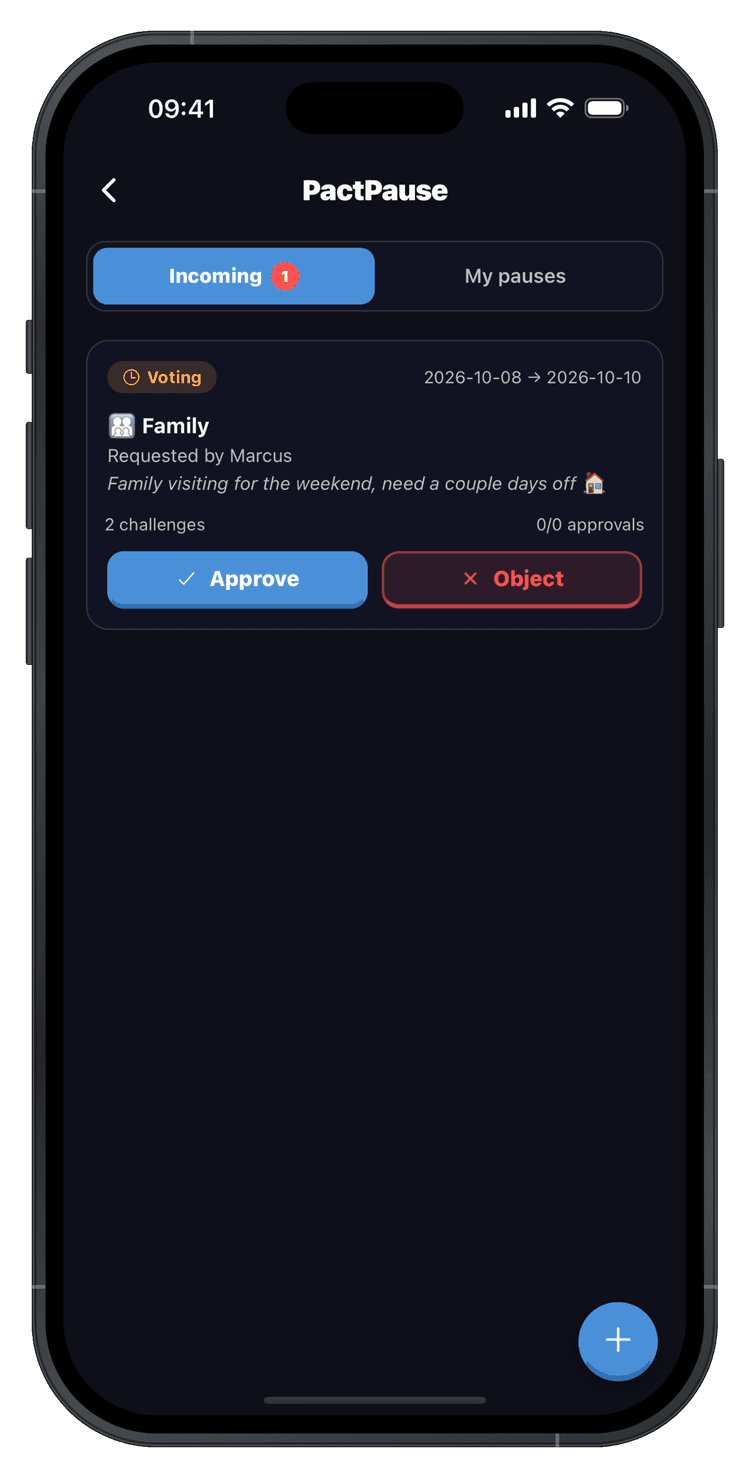
Some misses you can see coming: a week of flu, a trip with no routine. For those, it helps to pause on purpose instead of drifting. In Daily Pact that's PactPause: you ask your pact for a break, the others vote, and the paused days don't break your streak or count against your completion rate.
6. Make it visible to someone else. Habit research focuses on repetition, and the hardest part of repetition is the days you don't feel like it. That's where other people help. In a 1999 weight-loss study by Wing and Jeffery, people who joined with friends were more likely to finish the program (95% versus 76%) and to maintain their weight loss at 10 months (66% versus 24%) than those who joined alone. A friend who sees whether you showed up turns a private intention into a small public commitment. If you want one, here's how to find an accountabilibuddy. And on day 40, when the habit is neither new nor automatic, a notification that your friend just checked in is often the cue that gets you to do yours.
What this means for a 31-day January challenge
If the median is around two months, is a 31-day challenge pointless? No. It's a good first stage, as long as you know what it's for.
What 31 days does: it gets you roughly halfway up the curve for a simple daily habit. That's when the habit stops needing a big decision every day and starts needing only a small one. It also gets you through the worst stretch of the year for resolutions. Strava's activity data has pointed to the second Friday of January as the day people are most likely to quit, which is why it's known as Quitter's Day. In 2027 that's January 8.
What 31 days doesn't do: it won't make most habits fully automatic. If you stop on February 1, expect the habit to fade.
So plan January as phase one:
- Pick one small daily habit with a clear yes or no. Our hub on goals for the new year has ideas.
- Attach it to a fixed cue, like "after breakfast" or "when I get home from work".
- Do it with one friend and check in every day. See the January challenge for a ready-made format.
- Track it where you can see it. A printable habit tracker on the fridge works, or an app.
- On January 31, keep going. Same habit, same cue, through February and into March. That takes you past the 66-day median.
Day 66 of 2027 is March 7. That's a better finish line for a habit than January 31, and a much better one than January 21.
Building the habit with a friend
This is what I built Daily Pact for. You start a pact with one friend or a small group, pick one small daily habit, and check in with one tap. Everyone sees who showed up, the streak grows together, and if you miss a day, you pick it back up the next one instead of starting over in silence. For January 2027 we're running the January Pact: one habit, one friend, all 31 days. Don't quit alone.
If you'd rather compare tools first, see our roundup of accountability apps.
Frequently asked questions
Is it 21 days or 66 days to form a habit? Neither is a rule. The 21-day figure comes from a 1960 observation by Maxwell Maltz about adjusting to change. The 66-day figure is the median from Lally et al. (2010), where individuals ranged from 18 to 254 days.
How long does it take to form a habit for exercise? Usually longer than for simpler habits. In the Lally study, more effortful behaviors like exercise tended to take longer to become automatic than drinking water or eating fruit. Start with a small version, such as a 10-minute walk.
Does missing a day reset habit formation? No. Lally et al. found a single missed day did not materially affect the process. The risk is letting one miss become several.
What is the 21/90 rule? It's a popular saying: 21 days to build a habit, 90 days to make it a lifestyle. It isn't based on research. It's a motivational framing built on the 21-day myth.
Can I form a habit in 30 days? For some simple habits, some people get there that fast. For most, 30 days is about halfway. Treat a 30-day challenge as a strong start and keep going after it ends.

Ready to build habits with friends?
Start your 14-day free trial. No credit card required.