My goal for 2027
1My goal
One goal, one sentence. Specific enough that a friend could tell whether you did it.
2Why it matters to me
The reason you'll need on a cold Tuesday in February.
3One daily habit that moves me toward it
Small enough to do on your worst day. Write the full version and the smallest version that still counts.
Every day I will: ___________________________________________________
On a bad day, at least: ______________________________________________
When (time or trigger): ______________________________________________
4Who will do it with me
One person who will see whether you showed up, and whose check-in you'll see too.
Name: ___________________________ We check in by: ___________________________
5Obstacles and if-then plans
Name what will get in the way, then decide now what you'll do when it does.
| If (obstacle)... | ...then I will |
|---|---|
If I miss a day, I will: ____________________________________________
631-day check boxes
Month: ____________________ Tick one box for every day you did the habit.
7Monthly review
On the last day of the month. For a fuller review, print the Monthly review sheet.
Days done: ______ / ______ Next month I will (circle): KEEP GROW CHANGE
What helped, what got in the way: ________________________________________
daily-pact.com/tools/goal-setting-worksheet
Why this goal setting worksheet is different
Most goal setting worksheets stop at the goal. You write down something big, add a deadline, maybe break it into milestones, and then the sheet goes in a drawer. The goal was fine. What was missing was anything to do today, and anyone who would notice if you didn't.
So this one is built around three questions instead: what is the one daily habit that moves you toward the goal, who will do it with you, and what will you do when something gets in the way. The last part of the sheet is a month of check boxes, because a goal you only look at in December is a wish.
How to fill it in
Give it 15 minutes with a pen. If you're doing it with a friend, fill in your own sheets side by side and swap at the end.
1. My goal
Write one goal in one sentence, specific enough that a friend could look at it in December and say whether you did it. "Run a 5K without stopping by June" works. "Get fit" doesn't. If you have five goals, pick the one that would make the other four easier and give it its own sheet.
2. Why it matters to me
Skip the reason you'd give at a dinner party and write the one you'd actually use on a cold Tuesday in February. "So I can keep up with my kids" beats "to be healthier". This is the box you'll reread when the habit starts to feel optional.
3. One daily habit
Goals are outcomes. You can't do an outcome today, but you can do a habit. Write the daily action that moves you toward the goal, the smallest version that still counts on a bad day, and the moment it happens (after coffee, on the way home, before bed). One habit, not three.
4. Who will do it with me
Write one name. Not a crowd, not "social media", one person who will notice if you stop and whose progress you'll see too. Agree how you'll check in: a message, a shared sheet on the fridge, or an app.
5. Obstacles and if-then plans
List the three things most likely to stop you, then write what you'll do when each one happens. "If I get home after 8pm, then I walk for 10 minutes instead of 30." Also fill in the missed-day line: the plan for the day after a miss matters more than the miss.
6. 31-day check boxes
Tick a box every day you do the habit. Write the month at the top. One month won't make the habit automatic, but it will tell you whether the habit is the right size.
7. Monthly review
On the last day of the month, count the boxes and circle one: keep, grow or change. Then print the Monthly review sheet for next month. Twelve reviews is a year of goal setting that actually adjusts to your life.
A filled-in example
Goal: Run a 5K without stopping by June 2027.
Why: I get out of breath on the stairs at work and I'm 34.
Daily habit: Run-walk for 15 minutes after work. On a bad day, at least 5 minutes of walking outside.
With me: Sam. We send each other a thumbs-up by 8pm.
If-then plans: If it's raining, then I do 15 minutes of stairs at home. If I work late, then I walk at lunch instead. If I miss a day, then I go out the next morning before work. If I'm ill, then I ask Sam for a pause instead of quietly stopping.
Notice that nothing in the example depends on motivation. The habit is small, the backup is smaller, and someone is waiting for the thumbs-up.
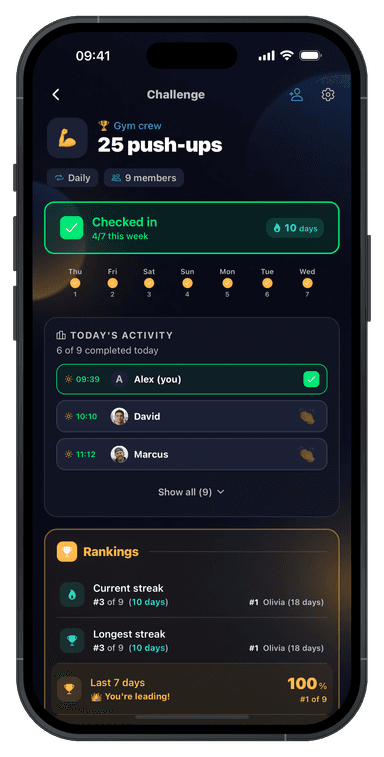
The daily thumbs-up is the part that tends to slip first, because it's one more message to remember. In Daily Pact it happens on its own: you tick the habit with one tap, Sam gets a notification, and you see Sam's check-in the moment it lands. Set a daily reminder for the time on your worksheet, and if one of you is ill, ask the other for a PactPause so the streak survives the week.
The research behind the boxes
If-then plans work. Psychologist Peter Gollwitzer called them implementation intentions, and a 2006 meta-analysis by Gollwitzer and Sheeran across 94 studies found they had a medium-to-large effect on whether people reached their goals. Deciding in advance removes the decision from the moment when you're least able to make it.
Doing it with someone works. In Wing and Jeffery's 1999 study, 95% of people who signed up with friends completed a weight-loss program and 66% kept the weight off at 10 months, compared with 76% and 24% of people who signed up alone.
Habits take longer than a month. Lally et al. (2010) found it took a median of 66 days for a daily behavior to feel automatic, with a range of 18 to 254. That's why the worksheet ends with a monthly review rather than a finish line. More on that in how long it takes to form a habit.
Using the worksheet for New Year 2027
Fill it in before January 1, not on it. If you need help choosing, start with goals for the new year or this list of New Year's resolution ideas, and read how to keep New Year's resolutions before you sign it.
Then put the daily habit to work in the January challenge: one small habit and one friend, every day from January 1 to 31, 2027. The habit tracker printable has a January 2027 sheet and a two-person pact tracker if you want more room than the 31 boxes here. Prefer smaller steps? Try monthly goals instead of one big yearly one.
If your partner doesn't live with you, paper stops working the day you can't see each other's sheet. That's what Daily Pact is for: you start a pact with your friend, both check in with one tap, and you each see who showed up today.
Common questions
What should be on a goal setting worksheet?
At minimum: the goal written specifically, why it matters to you, the daily action that moves you toward it, and a way to track that action. This worksheet adds two things most templates skip: a person who will do it with you, and if-then plans for the obstacles you already know are coming.
Is this goal setting worksheet free to print?
Yes. Print it as many times as you like, with no signup, email or watermark. Press Print above and it fits one portrait page on US Letter or A4. Print one for each goal and a fresh Monthly review sheet each month.
How many goals should I set for 2027?
One to three, and start with one. Each goal needs its own daily habit, and three new daily habits at once is where most New Year plans fall apart. Get the first one running, then add the next with a new sheet.
Why does the worksheet ask who will do it with me?
Because a goal someone else can see is harder to drop quietly. In Wing and Jeffery's 1999 weight-loss study, people who joined with friends were far more likely to finish and to keep the weight off than people who joined alone. Writing a partner's name down is the first step to making that real.
What is an if-then plan?
An if-then plan, or implementation intention, links a situation to an action: if this happens, then I will do that. Peter Gollwitzer's research on implementation intentions found that deciding the response in advance makes people more likely to follow through, because there is no decision left to make in the moment.

Do the daily habit with a friend
Start your 14-day free trial. No credit card required.
5.0 from 12 App Store ratingsAvailable on iPhone & Android · 14 days free for new accounts