
Try Daily Pact free for 14 days
Group challenges, leaderboards & streak tracking with your friends. No credit card required.
A month is close to the right length for a challenge. Long enough that finishing means something, short enough that you can see the end from the start — which is the part a vague "I'm going to get fitter this year" never gives you.
Here's one for each month, chosen to work with the season instead of against it. Trying to start a 6am running habit in January in the dark is not discipline, it's bad scheduling.
January — Dry January, or a quieter version
The obvious one, and it works because half the country is doing it at the same time. If alcohol isn't your thing, the January version of this is any subtraction: no takeaways, no phone in the bedroom, no doomscrolling before 9am.
Why it works in January: everyone else is also attempting something, so the social cost of taking part is zero.
February — 28 days of movement
Short month, low bar. Twenty minutes of deliberate movement a day, walking included. February is grim and the goal is a floor you cannot fail, not a training block.
March — The morning hour
Light comes back. Claim the first hour: no phone, one useful thing — reading, stretching, writing, whatever survives contact with a tired morning.
April — Spring clear-out
One item leaves the house every day. Thirty items in a month, and unlike most challenges the evidence accumulates in plain view.
May — Outside every day
Twenty minutes outdoors, daily, no exceptions for weather. The lowest-effort challenge here and reliably one of the most felt.
June — The 10,000-step month
Long days make this the easiest month of the year to hit a step target. Pair it with a friend and compare weekly totals rather than daily ones — daily comparison gets discouraging fast when someone has a desk job.
July — Read every day
Twenty pages, or fifteen minutes. Holidays make July unusually forgiving for a reading habit, and unusually hostile to anything requiring a gym.
August — No-spend month
Pick a category — eating out, clothes, subscriptions — and cut it for the month. Track every purchase you don't make. The number at the end is usually the motivating part.
September — Back to routine
The real new year. September is when structure returns, which makes it the best month of the twelve to start something you intend to keep: a fixed bedtime, a training plan, a language.
October — 30 days of strength
Cold enough to be indoors, not yet December. Bodyweight is fine — press-ups, squats, a plank. Progressive, so week four is visibly harder than week one.
November — Gratitude, written down
Three things a day, in writing. It sounds soft and it is the most consistently reported-effective thing on this list. November is dark and this is a deliberate counterweight.
December — Ten minutes of calm
Do not attempt an ambitious challenge in December; you will lose and it will sour January. Ten minutes of quiet a day is achievable in the worst week of the year.
Monthly challenge ideas for work
A team challenge needs two extra rules: opt in by join code, never by roster, and keep it to a yes/no check-in so nobody shares health data. With that settled, these run well in an office or a remote team:
- Walk at lunch — 20 minutes, every workday
- No meetings before 10am — four days a week
- Inbox zero by end of day
- Log off by 6pm
- Take the stairs all day
- One learning session a week — a course, a talk, a book chapter
- Bring lunch three days a week
- A screen-free lunch
Our guide to team accountability apps covers what it costs for 10, 20 or 50 people and how to keep it voluntary.
How long should a monthly challenge be?
The whole month, but with a rule agreed on day one about what a missed day means.
This matters more than the challenge you pick. Most people don't quit on the day they miss — they quit two or three days later, once the gap has quietly turned from an accident into a decision. Decide in advance: a miss costs you the day and nothing else. Groups that skip this step reliably fall apart in week two, every time.
Two other things that decide whether a monthly challenge survives:
- Make it binary. At the end of the day the answer has to be yes or no. "Read 20 pages" works. "Read more" doesn't, because on a bad day you'll negotiate with yourself and win.
- Make it visible to someone. A challenge nobody else can see is a promise you're free to renegotiate. This is the entire mechanism, and it's why the same challenge that dies alone survives in a group.
Running these with friends
Every challenge above works better with two or three other people doing the same one — not for encouragement, but because someone notices.
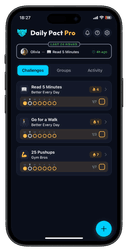
You can run it from a group chat, and plenty do. It holds for about a week: check-ins get quieter, one person goes silent, everyone reads it as permission, and it ends without anyone announcing it. That exact failure is why we built Daily Pact — a private group, one shared challenge, one-tap check-in, and a leaderboard so being behind is visible without anyone having to bring it up.
More ideas: daily challenges if a month feels long, 30-day challenge ideas for the full list, or self care challenges for the gentler end.

Ready to build habits with friends?
Start your 14-day free trial — no credit card required.