An accountability partner agreement is a one-page note where you and a friend write down what each of you will do, how you'll check in, and what happens when someone misses. It takes ten minutes, and it fixes the most common reason accountability partnerships fall apart: nobody agreed on the rules, so the first missed day turns into awkward silence.
Below is a free template you can copy, a filled-in example, and how to use it for a New Year's resolution. It's not a legal document. Nobody is getting sued for skipping a run. It's a shared memory, written down so neither of you has to remember or renegotiate it later.
Why write an accountability partner contract at all?
Most pairs agree on the goal and skip everything else. That works until the first bad week. Then questions come up that nobody answered in advance:
- Does a missed day mean the deal is off?
- Is it okay to nudge, or is that nagging?
- When does this end? Is it forever?
- What if one of you gets sick or travels?
An agreement answers these while you're both still motivated and friendly. That's the whole point. Deciding the missed-day rule on day one is easy. Deciding it on day 12, when one of you has just missed three in a row, is a confrontation.
There's also some decent evidence that writing commitments down and sharing progress helps. In a goal-setting study by Gail Matthews at Dominican University of California, participants who wrote down goals, committed to actions and sent weekly progress reports to a friend achieved more than those who only thought about their goals. It's a single, modest study, so take the exact numbers lightly, but the direction is consistent: written, shared, reported beats private. We cover the research in more depth in what an accountability partner is.
What goes in an accountability partnership agreement
A good accountability partnership agreement has seven parts. Skip any of them and you'll end up deciding it later, under pressure.
- Who. Both names.
- Each person's commitment. One specific, yes-or-no habit each. "Walk 20 minutes" works. "Be more active" doesn't.
- Dates. A start date and an end date. 30 days, or a calendar month, is the sweet spot.
- Check-in rhythm. How and when you report. Daily for daily habits, plus a short weekly review.
- The missed-day rule. What a miss means, decided before it happens.
- How to nudge. What your partner is allowed to say, and when.
- The ending. What you do on the last day: celebrate, review, decide on round two.
Optional extras: a small stake (loser buys coffee), a pause rule for illness or travel, and a "what I need from you" line for each person.
The free accountability partner agreement template
Copy everything in the box below into a note, a shared doc or the chat you use with your partner. Fill in the brackets together, then both reply "agreed".
ACCOUNTABILITY PARTNER AGREEMENT
Partners: [Name 1] and [Name 2]
Start date: [date] End date: [date]
[Name 1] commits to: [one specific habit], [how often], by [time of day].
[Name 2] commits to: [one specific habit], [how often], by [time of day].
Daily check-in: Each of us checks in by [time] in [app or chat thread]. A check-in is one word or one tap: done, or not done.
Weekly review: Every [day] at [time], 5 minutes. Each of us answers: How many days did I do it? What made the hard day hard? What's one change for next week?
If one of us misses a day: The day is lost, nothing else. We start again the next day. No apologies needed, no lectures given.
If one of us misses [2 or 3] days in a row: The other sends one friendly message. We either restart or make the habit smaller. We don't quietly drop it.
Pauses: If one of us is sick, traveling or has a real emergency, we can pause for up to [number] days by telling the other in advance or the same day.
Nudges: [Name 1] wants [a nudge at a set time / a nudge only if I haven't checked in by X / no nudges]. [Name 2] wants [same options].
Stakes (optional): [e.g. whoever has fewer check-ins buys coffee].
At the end: We compare totals, celebrate whatever we got, and decide together whether to do another round with the same or a new habit.
Agreed: [Name 1], [date]. [Name 2], [date].
Tips for filling it in
- Make the habit smaller than you think. Your commitment should be doable on your worst day of the month. You can always do more.
- Attach it to a time or a cue. "After my morning coffee" or "before 8pm" is easier to keep than "sometime today".
- Pick the gentlest missed-day rule you can both accept. Harsh rules feel motivating on day one and make people quit on day ten.
- Keep it to one page. If it's longer, it's a project plan, not an agreement.
A filled-in example
Here is the same accountability partner contract filled in by two friends doing a January habit together.
ACCOUNTABILITY PARTNER AGREEMENT
Partners: Maya and Jonas
Start date: January 1, 2027 End date: January 31, 2027
Maya commits to: a 20-minute walk, every day, by 7pm.
Jonas commits to: reading 10 pages of a book, every day, before bed.
Daily check-in: Each of us taps check-in in our shared pact by 10pm.
Weekly review: Sundays at 8pm, 5 minutes on a call. Days done, the hard day, one change.
If one of us misses a day: The day is lost, nothing else. Restart tomorrow.
If one of us misses 2 days in a row: The other sends one message: "Restart tomorrow, or shrink it?" Maya's smaller version is a 10-minute walk. Jonas's is 3 pages.
Pauses: Up to 3 days for illness or travel. Jonas is away January 15 to 17, so those are pre-approved.
Nudges: Maya wants a nudge at 6pm if she hasn't checked in. Jonas wants no nudges, just the weekly review.
Stakes: Whoever has fewer check-ins on January 31 buys brunch.
At the end: Compare totals on February 1, then decide on a February habit.
Agreed: Maya, December 28, 2026. Jonas, December 28, 2026.
Notice what makes this one work. Each habit is tiny and binary. The smaller fallback version is decided in advance. The trip is handled before it happens. And they each picked the kind of nudge they actually want, so nobody feels policed.
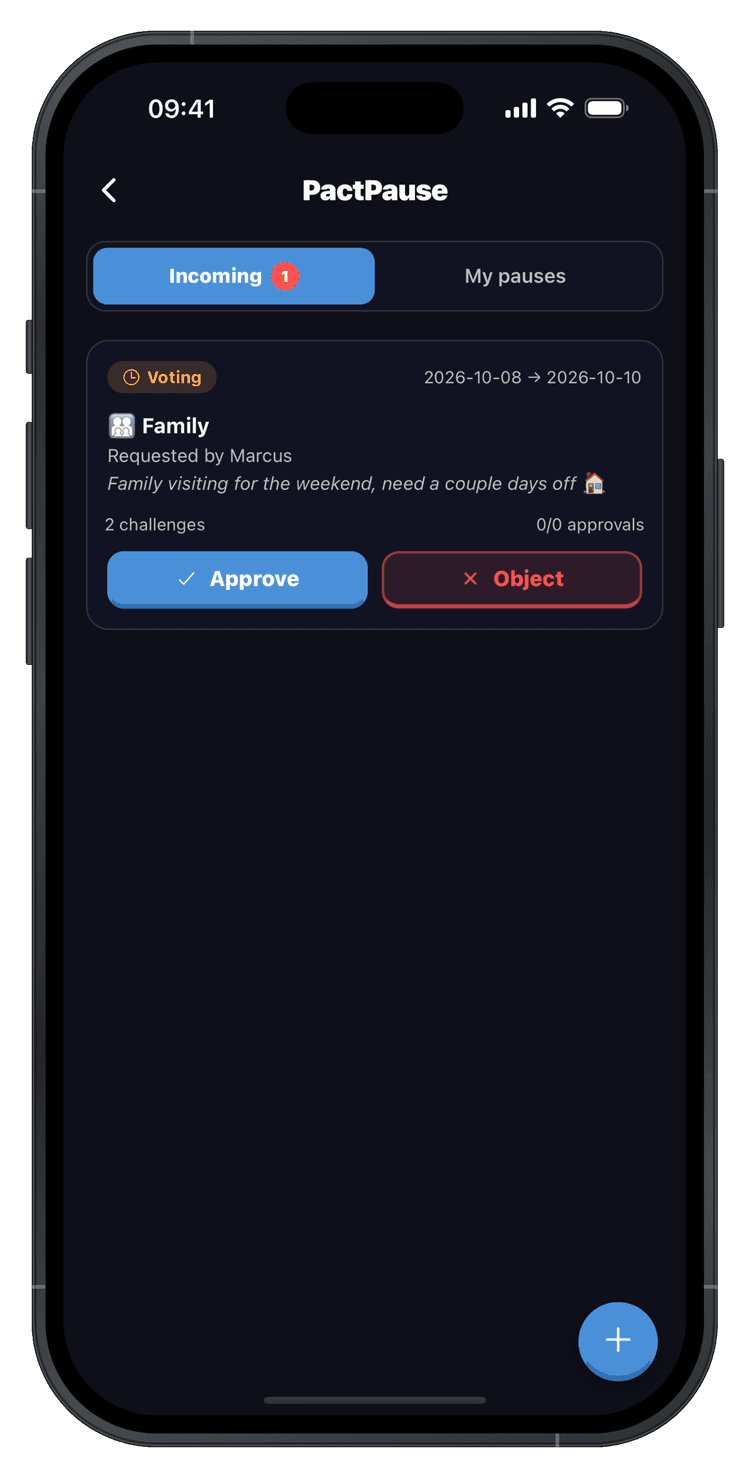
Two of these clauses are easier to keep with an app than with good intentions. Maya's 6pm nudge can be a reminder she sets herself in Daily Pact, so Jonas never has to play alarm clock, and if he wants to nudge her anyway it's one tap instead of a "so... did you walk?" text. Jonas's pre-approved trip becomes a PactPause: he asks for January 15 to 17, Maya approves, and those days don't break his streak or drag down his numbers.
How to use it for a New Year's resolution
Resolutions fail in a predictable pattern. Strava's analysis of its users' activity pointed to the second Friday of January as the day people are most likely to give up, which is why it's often called Quitter's Day. In 2027 that's Friday, January 8. An agreement is a cheap way to get past it.
Here's how to use the template for January 2027:
- Turn the resolution into one daily action. "Get fit" becomes "walk 20 minutes". "Read more" becomes "10 pages". Our hub on goals for the new year helps you pick one.
- Find your partner before New Year. Ask in the last two weeks of December, while everyone is thinking about it. Not sure who? See how to find an accountabilibuddy.
- Fill in the agreement together on December 28 to 31. Set January 1 as the start and January 31 as the end. One month, not one year.
- Pre-approve the hard days. Back-to-work week, any trips, the first weekend of bad weather. Decide the smaller version of your habit now.
- Plan the January 8 check-in. Add a short message or call on Quitter's Day itself: "We're past day 7. Still in?" If you check in through a shared pact, you'll already know by the evening whether your partner showed up that day, so the message can be a cheer instead of a question.
- Review on February 1. Then sign a new agreement for February, with the same habit or a new one.
If you want to see your January on paper, print a habit tracker and stick it next to the agreement. For more on getting past the first few weeks, read how to keep New Year's resolutions.
Putting the agreement into an app
Writing the agreement is the easy part. Keeping the daily check-in going is harder, because a chat thread depends on someone remembering and someone being willing to ask. In Daily Pact the agreement maps straight onto a pact: you and your partner pick the habit, set it to daily, and check in with one tap. You both see who showed up, the streak is shared, and the reminder comes from the app instead of your friend. Pauses work the same way, with PactPause for sick days and trips.
If you're comparing tools first, our guide to the best accountability partner app options covers free and paid choices.
Frequently asked questions
Is an accountability partner agreement legally binding? No. It's an informal commitment between friends, not a contract in the legal sense. Its value is that it settles the rules before anyone needs them.
How long should an accountability partner contract last? Start with 30 days or one calendar month. A clear end date makes it easier to finish, and you can sign a new one for the next month.
What should happen if my partner breaks the agreement? Follow the missed-day rule you wrote down. If it keeps happening, have one honest conversation, then either shrink the habits or add a third person to make it a small group.
Can a group use this template? Yes. Add a line per person and keep the same rules. For three or more people, our guide to starting an accountability group covers group size and cadence.
Do we need the same goal? No. Different habits work fine. What matters is that you both check in on the same schedule and follow the same rules.

Ready to build habits with friends?
Start your 14-day free trial. No credit card required.