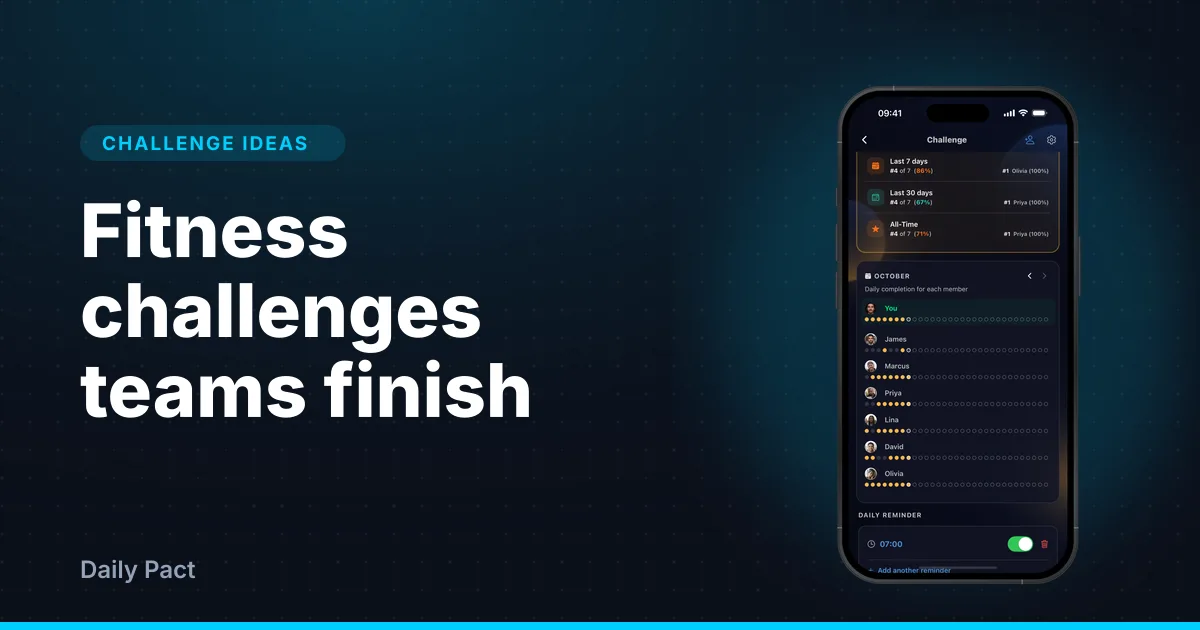
The best workplace fitness challenge ideas are short daily movement habits everyone can do in work clothes: a 10-minute walk, the stairs instead of the lift, 10 squats with every coffee, a plank a day. Run them in small teams of three to five, score days completed instead of distance, and plan what happens after the last day.

Most office fitness challenges follow the same curve. Week one is loud, the leaderboard is full and the same five sporty people pull away. By week three half the office has stopped logging, and the week after the challenge ends, everyone is back where they started.
That last part isn't a guess. In a six-week team step challenge at the University of Würzburg, 331 employees in 44 teams went from 8,955 to 10,653 steps a day, about 1,700 more. In the three weeks after it ended, they averaged 8,514 (Manger et al., Frontiers in Public Health, 2025). The challenge worked while it ran. Nobody planned for the day after.
So this list does two things: 20 fitness challenges that work for a mixed office, and a way to run them so the habit survives the finish line. If you want sleep, focus and social challenges too, see our employee wellness challenge ideas.
What makes a good workplace fitness challenge
A good workplace fitness challenge is something every colleague can do on a busy day without a shower afterwards, with a clear yes or no each day, scored so the least fit person can still win. If only the runners can win, everyone else stops logging by week two.
- Ten minutes or less on a normal day. People with kids, long commutes or back-to-back meetings drop out first when a challenge asks for an hour.
- Score consistency, not performance. Rank by days completed. A "most kilometres" contest is a race the same three people win.
- No gear, no changing room. Stairs, walks, squats and stretches work in office clothes. A gym-only challenge leaves out half the team.
- Works for the people at home too. Hybrid and remote colleagues need a version they can do in a kitchen.
Workplace fitness challenge ideas: walking and steps
Walking is the easiest place to start: no equipment, no skill, and it fits around meetings. These work for office and remote staff alike.
1. The 10-minute walk
Ten minutes of walking, any time of day, every workday. It sounds too small, which is exactly why people finish it. Lunch, between meetings and the walk to the train all count.
2. A reachable step target
Pick a daily number most of the team can actually hit, like 6,000 or 7,000 steps, not 10,000. In a team challenge at a US university system, people who joined as a team walked 1,922 more steps a day than colleagues who tracked steps alone, and were more likely to finish (Tullar et al., American Journal of Health Promotion, 2019). The target is a yes or no, so a 6,000-step day and a 15,000-step day both count as one.
3. Walking meetings
Turn one meeting a day into a walk: one-on-ones and calls with the camera off work best. It adds movement without adding time to anyone's calendar.
4. Walk the distance together
Add up the whole team's steps toward a shared goal, like the distance to another office or to a city the team picks. It turns individual effort into one team number, and the slowest walker still moves the needle.
5. Lunchtime walk club
A fixed time, a fixed meeting point, whoever is free walks. Two to four weeks is enough to tell if it sticks. It's also the easiest way to get new starters talking to people outside their team.
Office fitness challenge ideas you can do at your desk
These are for days when nobody leaves the building. They take a minute or two and need no changing.
6. Stairs, every time
Take the stairs whenever it's three floors or fewer. Each person checks in when they skipped the lift all day. It's free, it's quick, and it raises heart rates more than people expect.
7. 10 squats with every coffee
Every time you make a coffee or tea, do 10 squats while the kettle boils. It ties the habit to something people already do several times a day, so nobody has to remember it.
8. A plank a day
Start at 20 seconds and add five seconds every few days. Anyone can do it on a meeting room floor. Keep the score as days done, not seconds held, or the strongest person wins in week one.
9. Stand up every hour
Stand, stretch or walk for two minutes at the top of every hour you're at your desk. A calendar reminder or a phone alarm does the prompting.
10. Push-up o'clock
At a set time each day, say 11:00, everyone does as many push-ups as they comfortably can. Knees on the floor or against a desk count. The point is the shared moment, not the number.
11. Ten minutes of mobility
Ten minutes of stretching or yoga, from a video or from memory. Good for the people who sit all day and for anyone who would never join a step contest.
Corporate fitness challenges for active teams
For teams that want something bigger. Keep the scoring fair and make sure there's a gentle version for everyone else.
12. 150 active minutes a week
The CDC recommends 150 minutes of moderate activity a week for adults (CDC, physical activity guidelines). That's about 30 minutes on five workdays, and any movement counts: walking, cycling, a class, gardening. Check in each day you got your 30.
13. Strength twice a week
The same guidelines ask for at least two days of muscle-strengthening activity a week. A two-day-a-week challenge is realistic for beginners: bodyweight at home, a gym session or a class all count.
14. Bike or walk to work
Check in on every day you walked, cycled or got off the bus a stop early. Great in spring, hard in January, so pick the season.
15. Couch to 5K as a team
Beginners follow a nine-week run-walk plan together, three sessions a week. Pair new runners with someone a little ahead of them, and celebrate finishing, not the time.
16. A weekly team workout
One fixed session a week: a lunchtime class, a run club after work or a video workout on a call for remote staff. Check in for showing up, nothing else.
17. The month of one sport
Pick one activity for a month: swimming, climbing, a dance class. People try something new and you get a natural end date. See our gym challenge ideas for more to choose from.
Fitness challenges for remote and hybrid teams
A fitness challenge for a remote team works when everyone can do it anywhere, check in from their phone, and see colleagues doing it the same day. Without that, remote staff feel like spectators of an office contest.
18. Camera-off walking calls
Any call that doesn't need a screen becomes a walk. Remote staff get the same movement the office walkers get.
19. Same time, different places
Everyone does the same five minutes at the same time, say 3pm squats or a stretch break, wherever they are. A shared moment works across offices and time zones if you pick a time that suits most people.
20. Show your walk
Each person posts one photo from their daily walk in the team chat. It's the lightest possible check-in and the one people keep doing, because it's nice to see where colleagues live.
| Challenge | Time a day | Equipment | Works remote | Best for |
|---|---|---|---|---|
| 10-minute walk | 10 min | None | Yes | Every team, a first challenge |
| Reachable step target | 30-60 min of walking | Phone | Yes | Teams that like numbers |
| Stairs, every time | 2-5 min | None | No | Offices with stairs |
| 10 squats with every coffee | 1 min | None | Yes | Desk-heavy teams |
| A plank a day | 1 min | None | Yes | Small, competitive teams |
| 150 active minutes a week | 30 min | None | Yes | Teams that already move |
| Strength twice a week | 20-45 min, 2 days | Optional | Yes | Beginners to strength |
| Couch to 5K | 30 min, 3 days | Shoes | Yes | New runners |
How to run a workplace fitness challenge that lasts
The idea matters less than the setup. These five steps are what separate a challenge people finish from one that fades in week three.
Split the office into small teams
Teams of three to five keep people going far longer than one big office-wide group. In the Daily Pact app data, 26.4% of habits shared by exactly three people were still active in week 4, against 3.1% for habits in groups of six or more, the same as people doing it alone.
Alone
3.1%
2 people
12.7%
3 people
26.4%
4-5 people
10.9%
6 or more
3.1%
Source: The Daily Pact Habits Report 2026.
See the numbers+
| People | Habits (n) | Alive in week 4 | Check-in days, month 1 |
|---|---|---|---|
| Alone | 1,615 | 3.1% | 1.5 |
| 2 people | 766 | 12.7% | 5.4 |
| 3 people | 444 | 26.4% | 8.9 |
| 4-5 people | 236 | 10.9% | 4.7 |
| 6 or more | 1,343 | 3.1% | 4.8 |
In a group of 40, nobody notices when you stop. In a team of four, everyone does. Mix fitness levels inside each team so no team is stacked, and let people pick at least one teammate they like.
Run it for four to six weeks
Long enough to feel like an achievement, short enough that the end is visible on day one. Start on a Monday. The Würzburg study ran six weeks; a 28-day challenge is easier to explain and still covers the week-three dip.
Score days completed, not distance
Every team's score is the share of days its members checked in. A team of three beginners who never miss a day beats a team of marathon runners who skip. That one rule keeps the people who need the challenge most from quitting.
Make check-ins daily and visible
A check-in colleagues can see reminds people the challenge exists and gives them a gentle reason to show up. A spreadsheet or a chat thread works for a week, then the updates stop. Decide up front that a missed day costs that day and nothing else: groups that treat one miss as failure lose people in week two.
Plan the day after
This is the step almost every workplace challenge skips, and it's why the steps disappear afterwards. Before the last day, agree on a smaller version people keep: three walks a week instead of five, or the stairs only. Start the next challenge after one week off, so there's always something on.
Best app for a workplace fitness challenge
The best app for a workplace fitness challenge lets every colleague check in with one tap on iPhone or Android, shows the team who moved today, works for any kind of exercise and doesn't make each employee pay. Step-only step challenge apps leave out squats, planks and classes, and big corporate wellness platforms are built for HR departments with long contracts.
Daily Pact is the app we build, so weigh this with that in mind. Here's how a team challenge works in it:
- Create one group per team and set the habit, daily or a few times a week.
- Invite everyone at once: a link in Slack or Teams, the 6-character group code, several contacts at once, a list of up to 200 email addresses, or a QR code at the all-hands. On the web, organizers can paste emails or upload a CSV and see who opened and joined.
- Everyone checks in with one tap. The app sends reminders, so the organizer doesn't have to.
- Leaderboards and streaks show which team is keeping it going.
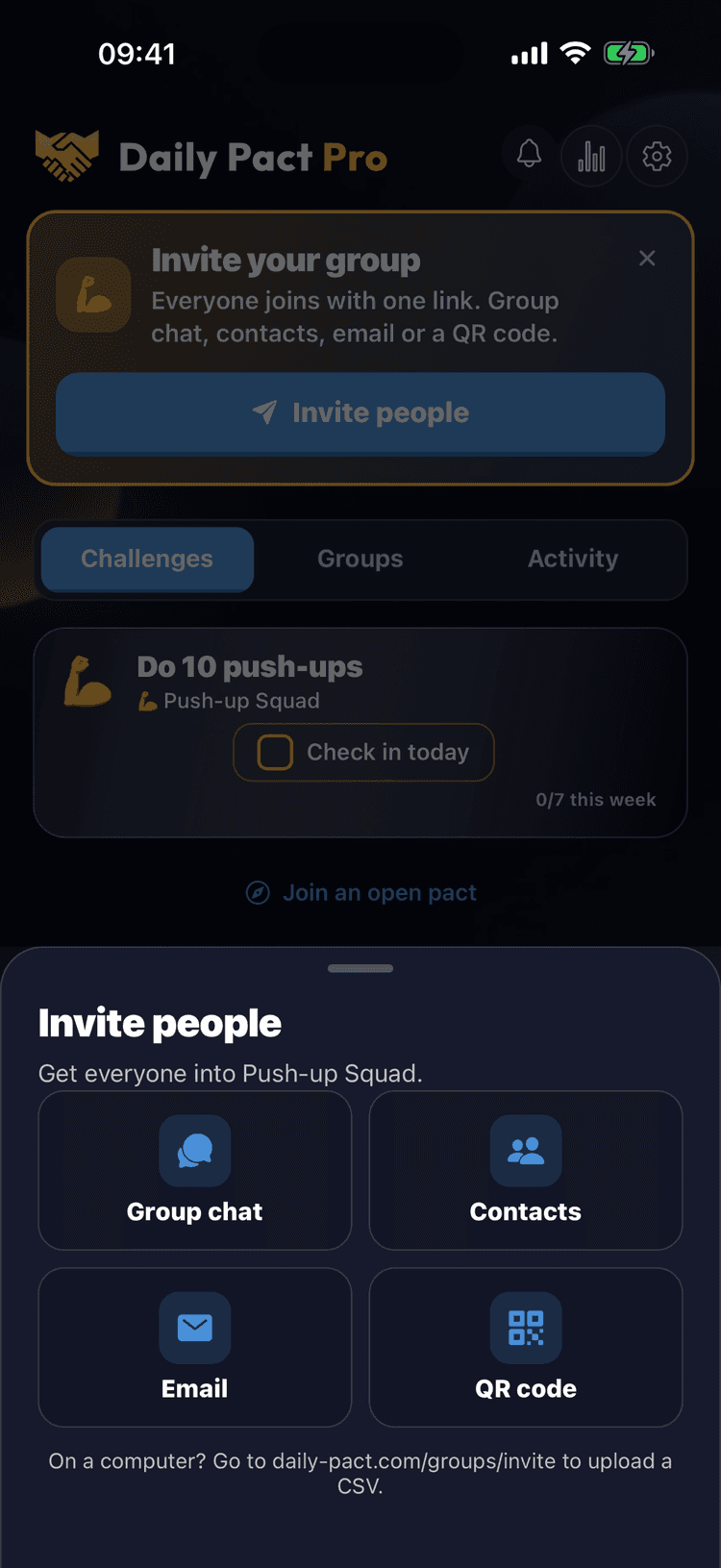
Normally each person gets a 14-day free trial and then pays for Pro themselves, and in a workplace challenge people drop off at the payment screen. With the Group plan, one person, usually the team lead or whoever runs wellness, pays and covers everyone in their groups. Members join free and never see a paywall. Plans cover up to 15 people for $9.99 a month, up to 50 for $24.99 and up to 200 for $49.99 (yearly saves two months). There is no free trial on Group plans. See how it works for workplaces.
Frequently asked questions
What are some examples of workplace fitness challenges?
A 10-minute daily walk, a reachable step target like 7,000 a day, taking the stairs every time, 10 squats with every coffee, a plank a day, walking meetings, and 150 active minutes a week. Pick one, run it for four to six weeks in small teams and score days completed.
What is a good exercise challenge for employees?
One that everyone can do in work clothes in ten minutes or less, with a clear yes or no each day. A 10-minute walk or the stairs challenge works for every fitness level, which matters more than how hard it is.
How long should a workplace fitness challenge last?
Four to six weeks. Shorter and nothing changes, longer and people lose interest. Before the last day, agree on a smaller version to keep, because steps tend to drop back once a challenge ends.
How do you make a fitness challenge fair for all fitness levels?
Score days completed instead of distance, steps or weight, mix fitness levels inside each team, and keep the daily target reachable. Then a beginner who never misses a day can beat a marathon runner.
How do you run a fitness challenge for a remote team?
Pick a habit people can do anywhere, like a daily walk or five minutes of squats at the same time, and use an app where everyone checks in from their phone and sees who moved today. See our fun team challenges for more ideas.