The short answer

Daily Pact
Our pick★ 5.0 on the App StoreFor a group with different phones and watches.
Set a daily step target, count with whatever you each have, and tap once in Daily Pact when you've hit it. Everyone's on the same leaderboard, nobody's step data goes anywhere, and PactPause covers a sick day. iPhone and Android. Free for 14 days, then $0.99 a month, or one organizer covers the group.

If that doesn't fit you
- Everyone has a wearable and wants exact totals: Stridekick, organizer pays from $12.99 a month, or StepUp, free.
- Nobody has a wearable but you want real counts: Pacer counts from the phone, free.
- It's a company-wide program: MoveSpring, through your employer.
- It's two Apple Watch owners: the built-in Fitness competition.
Quick comparison
| App | Groups | Counts steps | iPhone + Android | Free tier | Organizer pays | Price | Platforms |
|---|---|---|---|---|---|---|---|
 Daily PactOur pickManual check-in, any counter | $0.99/mo each, or Group plan from $9.99/mo | iOS · Android | |||||
| StridekickDevice sync, organizer pays | Free / from $12.99/mo | iOS · Android | |||||
| StepUpDevice sync, free | Free | iPhone · Watch | |||||
| PacerPhone pedometer, groups | Free / $49.99/yr | iOS · Android · Watch | |||||
| MoveSpringOrganization platform | Through your employer | iOS | |||||
| Apple Fitness competitionsWatch-to-watch | Free | Apple Watch |
Prices are US storefront, checked 21 October 2026. "Counts steps" means the app reads steps itself; Daily Pact records a check-in instead.
How we chose
We build Daily Pact, so read our pick with that in mind. Every app here was judged on the same questions: who notices when you skip, how fast the check-in is, what happens after a missed day, and what it really costs. We say plainly where another app does something we don't. The full policy is on our About page.

1. Daily Pact
Our pickCheck in when you hit your number, on any phone or watch
Daily Pact doesn't read your steps. The group agrees a daily target, everyone counts with whatever they have (iPhone Health, Google's counter, a Fitbit, a Garmin, a pedometer) and taps once when they've hit it. That's why it works for groups where the devices are mixed: nobody is excluded, nobody has to trust a sync, and nobody's health data leaves their phone. The leaderboard ranks the group by days completed, notifications show who has already walked, and PactPause covers a sick day. It's a fitness challenge app as much as a step challenge app: the same group can run a daily walk, a stairs-only month or a stretching challenge.
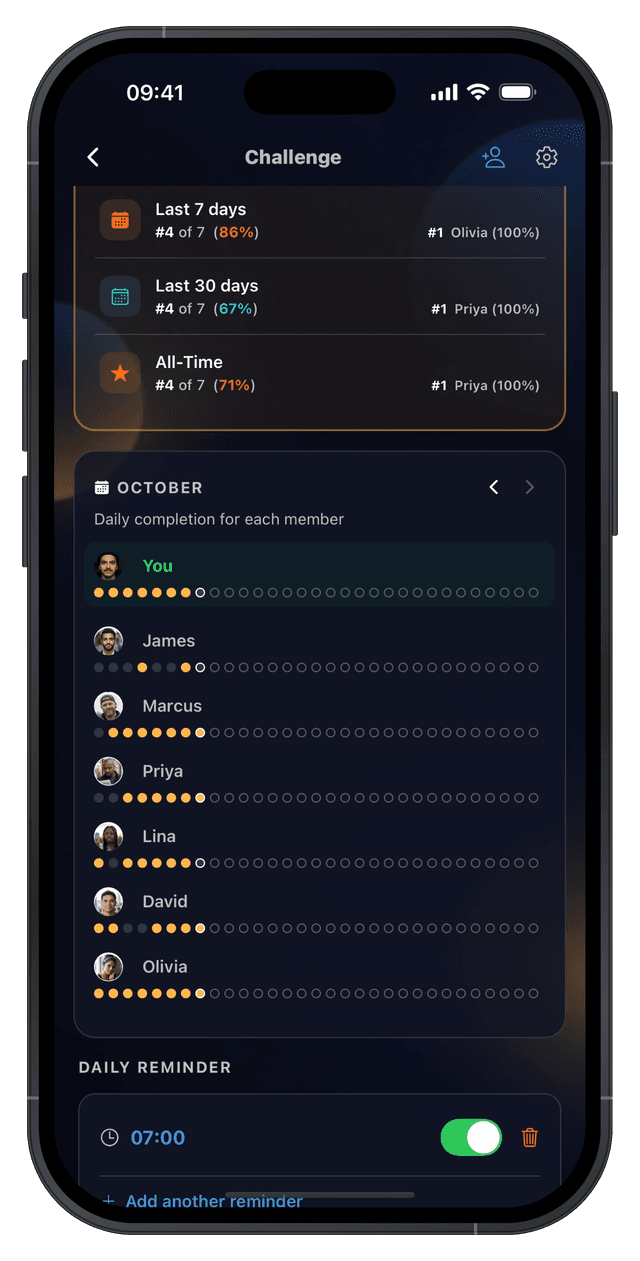


New accounts get 14 days free · No credit card
Pros
- Works with every phone and watch, or none
- Nobody's step data leaves their device
- Leaderboard by days hit, fair for every sensor
- PactPause for sick days and travel
- Groups up to 1,000; invite by link, contacts, email list or QR code
- Organizer can pay for everyone: Group plan from $9.99/mo for 15 people
Cons
- Trusts the tap: no step verification
- No free tier after 14 days
- No total-steps leaderboard
2. Stridekick
Synced steps from every major wearable
Stridekick reads activity from Fitbit, Apple Watch, iPhone, Android, Garmin, Withings, WHOOP and Oura, and runs challenges on the real numbers: leaderboard, target, virtual race, streak and custom activity. It's aimed at friends, families and workplaces alike. Only the organizer pays; participants join free. The free plan is public challenges of up to 7 days and 10 people. Private challenges need Pro: $12.99/mo for 10 people, $24.99/mo for 20 or $49.99/mo for 50 (up to 45 days). Team modes and longer challenges are on the Unlimited plan, priced through sales.
Pros
- Real step counts from every major device
- Five challenge modes on every plan
- Organizer pays once for the group
Cons
- Private challenges cost from $12.99/mo
- Free tier is 7 days and public
- Team leaderboards are Unlimited-plan only
3. StepUp
Free step leaderboards for friends and big groups
StepUp is a pedometer built around friends: daily, weekly and monthly leaderboards, cheering, taunting and chat. Its step challenges are free, from a few friends up to 15,000 people, with optional start and end dates, group chat, step reports for admins and a "Mystery Mode" that hides today's counts until the next day. It syncs with Apple Health and lists Apple Watch, Fitbit, Garmin, Oura, WHOOP, Withings, Samsung Health and more, and its App Store listing says iPhone and Android users can compete together. No subscription: in-app purchases are optional tips.
Pros
- Free challenges, no subscription
- Scales from a few friends to very large groups
- 4.8 stars from about 146,000 App Store ratings
Cons
- Step counts only, not other habits
- Competition is on totals, which favors big walkers
- Busy social feed
4. Pacer
A pedometer with walking groups
Pacer counts steps from your phone (and Apple Watch on iPhone), and lets you join walking groups, compete in friendly challenges and share progress with friends and family. It has one of the biggest user bases of any walking app, with a 4.9 rating from about 335,000 App Store ratings. Step counting is free; Pacer Premium is $49.99 a year for the extra features.
Pros
- Free step counting on your phone
- Walking groups and challenges
- Huge, active user base
Cons
- Premium ($49.99/yr) for the extras
- Phone-in-pocket counting misses some walks
- Lots going on in the app
5. MoveSpring
Step challenges run by your company
MoveSpring describes itself as a step and activity challenge platform for companies and organizations. An admin sets up the challenges (leaderboard, team leaderboard, journey, streak, target, group target and fundraiser modes), manages users and runs reports, and participants connect a Fitbit, Apple Watch, Garmin, Withings, Polar or their phone. It isn't something a friend group signs up for on its own: you join through your employer or organization.
Pros
- Built for workplace wellness programs
- Team and fundraiser modes
- Admin center with reports
Cons
- Organizations only, not friend groups
- Pricing isn't published
- You can't start one yourself
6. Apple Fitness competitions
Built in, if both of you have an Apple Watch
Apple Watch owners who share activity can challenge a friend to a seven-day competition from the Activity app or the Fitness app on iPhone. You earn points for the percentage of your Activity Rings you close each day, and whoever has the most points after a week wins. It's free, automatic and hard to fake. It's also one friend and one week at a time, and it scores rings rather than steps.
Pros
- Free and already installed
- Automatic and hard to fake
- Rings are motivating
Cons
- Apple Watch only
- Seven days, one friend per competition
- Scores rings, not steps
How to choose a step challenge app
Three questions decide it, and they matter more than any feature list.
- Does everyone have the same kind of device? If yes, a sync app like Stridekick or StepUp gives you exact numbers. If it's a mix of iPhones, Androids, watches and nothing, a check-in app like Daily Pact keeps everyone on one leaderboard.
- Who pays? Free apps work for friends. For a team or a club, it's usually easier if one person covers everyone: Stridekick Pro and the Daily Pact Group plan both work that way.
- Totals or days hit? Total steps rewards the longest commute and the best sensor. Days hit rewards showing up, which is fairer for a mixed group and keeps the slower walkers in it past week two.
Our step challenge with friends guide walks through the setup in detail: target, counting rule, length and app.
Best step challenge app for teams and work
For a company-wide program with HR reporting, wearable sync and team modes, look at MoveSpring or Stridekick's Unlimited plan. Both are built for organizations.
For one team that just wants a walking challenge this month, that's more than you need. One Daily Pact Group plan covers 50 people for $24.99 a month, and a check-in that says "I hit my target" isn't health data, so nobody has to share their step counts with work. Keep it opt-in by invitation, never by roster. See Daily Pact for workplaces and our team accountability app comparison.
Best step challenge app for families
Families are the hardest group for a sync app: kids without phones, a grandparent with a basic pedometer, a parent with a Garmin. Score by days hit, not totals, so a seven-year-old and a marathon runner can both win the week.
Daily Pact works here because it doesn't care about the device, and one parent can cover the whole family with a Group plan. If everyone has a wearable, Stridekick runs family step-offs too. More on that in Daily Pact for families.
What happened to Fitbit challenges?
Many people searching for a step challenge app used to run them in Fitbit. Fitbit retired its Challenges, Adventures and open groups in March 2023, and the app is now called Google Health. Its current App Store listing focuses on coaching, sleep and fitness plans and doesn't mention challenges.
If your group still wears Fitbits, Stridekick and StepUp both read Fitbit data, and Daily Pact works with any Fitbit because everyone simply checks in when their own device says they've hit the target.
Walking challenge ideas to run in any app
- 8,000 a day for 30 days: score by days hit
- 50,000 a week: forgiving of a rest day
- Lunch walk: 20 minutes every workday
- Walk to work: three commutes a week on foot
- Stairs only: no elevators for a month
- Weekend long walk: 10 km once a week
More in fitness challenges with friends, including group fitness challenge ideas for gyms and coaches.
Frequently Asked Questions
What is the best step challenge app?
It depends on your group. If everyone has a wearable and wants exact totals, Stridekick or StepUp. If devices are mixed, or some people have none, Daily Pact: everyone counts their own way and checks in when they hit the target. For a company program with HR reporting, MoveSpring. For two Apple Watch owners, the built-in Fitness competition.
Is there a free step challenge app?
Yes. StepUp's step challenges are free with optional tips. Pacer counts steps for free and has walking groups. Stridekick is free for public challenges of up to 7 days and 10 people. Apple Fitness competitions are free between Apple Watch owners. Daily Pact is free for 14 days, then $0.99 a month, or one organizer covers everyone with a Group plan.
What is the best walking challenge app for groups at work?
For a company-wide wellness program, MoveSpring or Stridekick's Unlimited plan, which are built for organizations with admin reporting. For a single team, a Daily Pact Group plan covers 50 people for $24.99 a month and records check-ins rather than step data.
Can iPhone and Android users do a step challenge together?
Yes. Stridekick, Pacer and Daily Pact all run on both. StepUp's App Store listing says iPhone and Android users can compete together. Apple Fitness competitions are the exception: both people need an Apple Watch.
Does Fitbit still have step challenges?
No. Fitbit retired Challenges, Adventures and open groups in March 2023, and the app is now Google Health. Stridekick and StepUp can read Fitbit data for a challenge, and Daily Pact works with a Fitbit through a daily check-in.
Related guides
Start a step challenge with your group, free for 14 days
Start your 14-day free trial. No credit card required.
5.0 from 12 App Store ratingsAvailable on iPhone & Android · 14 days free for new accounts