Key findings
88% vs 39%
of habits got a check-in in their first week when started with others, compared with alone.
3x
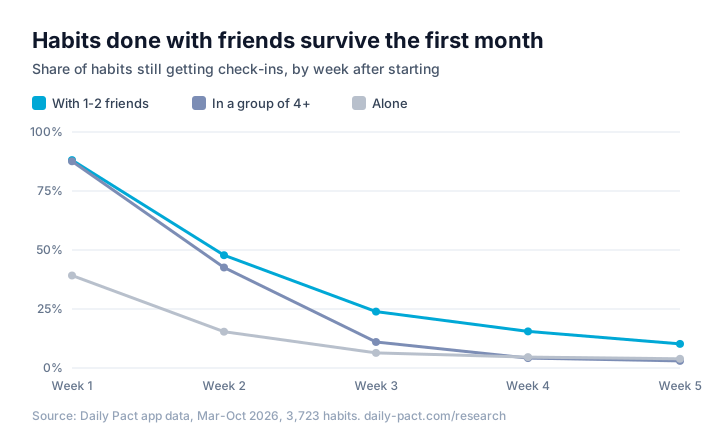
as many habits were still going in week 2 with others (45%) as alone (15%).
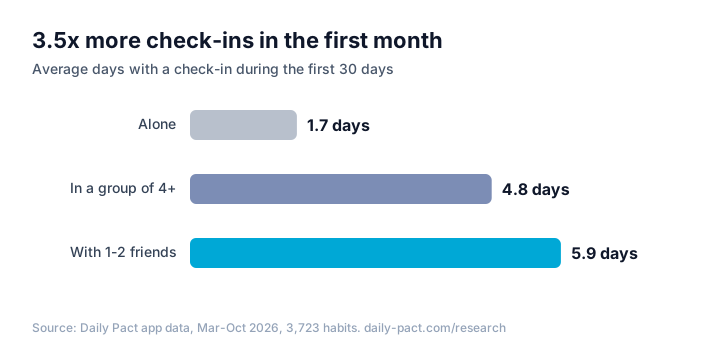
3.5x
more check-in days in the first month for habits shared with one or two friends.
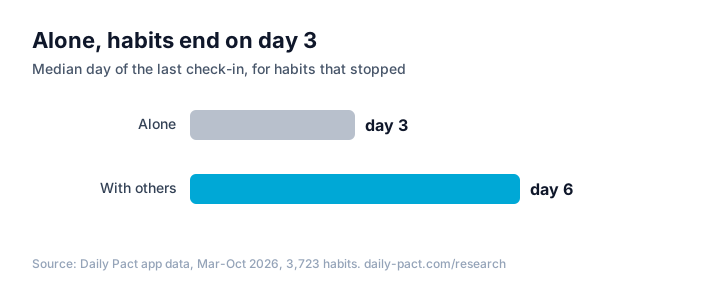
Day 3
is when the typical solo habit gets its last check-in. With others, it's day 6.
The first two weeks decide it
Most habits don't fail slowly. Of the habits in our data that stopped, 87% got their last check-in within two weeks, whether people did them alone or together. What changes with company is how many get through that window. Alone, fewer than 4 in 10 habits got a single check-in in their first week. With others, almost 9 in 10 did, and three times as many were still going in week two.
That fits what January looks like for most people. Strava's data famously puts the resolution cliff in the second week of January, the day it nicknamed Quitter's Day. Our numbers say the cheapest way over it is not more willpower but one other person who notices.
Small pacts beat big groups
The surprise was group size. Habits shared by two or three people did best: 16% were still getting check-ins in week four, against 5% alone. Groups of four or more started just as strongly, but by week four they had faded to the same level as people on their own. In a big group, one person going quiet is easy to miss. In a pact of two, it isn't.
Accountability without a camera
Body doubling, doing a task while someone else is present, is a popular strategy for people with ADHD, but most body-doubling tools need a live video session. A shared check-in works the same lever without the camera: someone will see whether you showed up today. The effect in our data shows up from the first week, which is where people who struggle to start need it most.
What to do with this
- Pick one or two people, not a crowd. Two or three is the size where everyone notices.
- Plan for week two, not week one. Starting is easy with company. The drop comes in days 7 to 14.
- Make checking in visible and quick. A daily one-tap check-in your partner can see does more than a private streak.
More on setting this up: how to start an accountability group and accountability apps for ADHD.
Method and limits
Data. Every habit started in Daily Pact between March 4 and October 11, 2026: 3,723 habits by 2,097 people, with 16,380 check-ins. Test, staff and complimentary accounts are excluded. We only used aggregate counts; no individual data is shared.
Definitions. A habit is one person doing one daily or weekly habit. “With others” means the habit had at least two participants, “with 1-2 friends” means two or three in total. Week 1 is days 0 to 6 after the person joined the habit. A habit counts as active in a week if it got at least one check-in that week, and each week only includes habits old enough to have reached it. The day-of-last-check-in figures cover the 2,052 habits with no check-in in the last 21 days.
Limits. This is app data, not a controlled trial. People who invite friends may be more motivated to begin with, so read the gap as a strong association, not proof of cause. Group size is measured today, not at the start. Long-term, most habits fade either way: after about five weeks only a few percent of habits are still getting check-ins in any group, so the effect we measure is on getting through the first month.
Use these charts
Free to use with a link back to this page. Copy the code below, or download the SVG.
Line chart: habit-survival-by-week.svg
Download SVG<a href="https://daily-pact.com/research/habits-with-friends"><img src="https://daily-pact.com/research/habit-survival-by-week.svg" alt="Line chart" width="720" style="max-width:100%;height:auto"></a> <p>Source: <a href="https://daily-pact.com/research/habits-with-friends">Daily Pact habit data</a></p>
Bar chart: checkin-days-first-month.svg
Download SVG<a href="https://daily-pact.com/research/habits-with-friends"><img src="https://daily-pact.com/research/checkin-days-first-month.svg" alt="Bar chart" width="720" style="max-width:100%;height:auto"></a> <p>Source: <a href="https://daily-pact.com/research/habits-with-friends">Daily Pact habit data</a></p>
Bar chart: quit-day.svg
Download SVG<a href="https://daily-pact.com/research/habits-with-friends"><img src="https://daily-pact.com/research/quit-day.svg" alt="Bar chart" width="720" style="max-width:100%;height:auto"></a> <p>Source: <a href="https://daily-pact.com/research/habits-with-friends">Daily Pact habit data</a></p>
Cite this
Daily Pact (2026). Habits done with friends are three times as likely to survive week two. https://daily-pact.com/research/habits-with-friends
Journalists: more cuts of the data, interviews and the press kit are available. Email info@guttae.se. Written by Alexander Lindgren, founder of Daily Pact.

Start a pact with one friend
Start your 14-day free trial. No credit card required.
5.0 from 13 App Store ratingsAvailable on iPhone & Android · 14 days free for new accounts