A no spend challenge means buying nothing nonessential for a set time, usually a week or a month, while still paying for rent, bills, groceries and getting to work. You write the rules down before day one, mark every no-spend day, and it works best with a friend or a small group doing the same month, so someone notices when you open the delivery app.
This guide covers the rules to agree first, what counts as essential, which length to pick, a tracker you can copy into the group chat, and how to keep going when week two gets boring. If you want the challenge to run inside a group with daily check-ins, see our 30-day challenge ideas for groups.

What is a no spend challenge?
It is a fixed-length break from discretionary spending: takeout, coffee runs, clothes, gadgets, new subscriptions and anything else you want but don't need. Essentials keep getting paid. The point is not to spend zero dollars, it is to stop the small automatic purchases and see where the money actually goes.
Fidelity describes it the same way: cut nonessential spending for a set period, keep paying for housing, basic groceries, hygiene, utilities, transportation and health care, and decide the length up front. They add that "many people opt for a month since it's ambitious yet achievable" (Fidelity).
What people usually find in the first week:
- Forgotten subscriptions. Streaming, apps and memberships you stopped using months ago.
- Small daily leaks. The coffee, the snack at the gas station, the "free shipping if you add one more thing."
- Boredom spending. Many purchases happen on a quiet evening, not because you needed something.
No spend challenge rules to set before day one
Write down three lists before you start: what you will still pay for, what is off limits, and what happens when something unexpected comes up. Written rules end the daily negotiation with yourself. If you do it with friends, everyone copies the same list so nobody argues about whether a latte is a need on day 11.
| Still paid (essentials) | Off limits (discretionary) | Agree as a group |
|---|---|---|
| Rent or mortgage, utilities | Takeout, restaurants, delivery | Gifts for birthdays already planned |
| Groceries from a list | Coffee and snacks bought out | Gas for a trip that was already booked |
| Transportation to work or school | Clothes, shoes, gadgets, decor | Kids' activities and school costs |
| Health care and medicine | New subscriptions, in-app purchases | One social meal a week, or none |
| Minimum debt payments, insurance | Hobby supplies, books, games | A small "fun money" amount, or zero |
Four rules make the difference between a challenge people finish and one they drop:
- Define essentials in writing. WalletHub's list of needs is a good starting point: rent or mortgage, utilities, gas, groceries, health care and minimum debt payments; nearly everything else is discretionary (WalletHub).
- Shop groceries from a list only. No list item, no purchase. Plan meals around what is already in the pantry and freezer.
- Emergencies are allowed. A medical bill or a car repair does not break the challenge. Pay it, note it, keep going.
- A slip extends the challenge, it doesn't end it. Fidelity suggests a group rule: whoever breaks the challenge adds one extra day each time they slip. It keeps people in instead of quitting after one bad day.
7, 30 or 90 days: which no spend challenge to pick
Start with a no spend week if you've never done this, a no spend month if you want a real reset, and 90 days only once a month has gone well. A week shows you the habits; a month changes some of them. Longer is not better if you quit on day 6.
| Length | Good for | What to expect |
|---|---|---|
| No spend weekend | Testing the idea | Shows how much of your weekend runs on spending |
| No spend week (7 days) | First try, busy months | Easy to finish; one or two cravings to plan around |
| No spend month (30 days) | A real reset before a goal | Week two is the hard part; savings show up by the end |
| 90 days | Paying down debt, a big goal | Needs a few planned exceptions and a group that stays in |
Pick a quiet month. Avoid months with holidays, a vacation or a run of birthdays. That makes January and February popular: the gift season is over and people want a fresh start. If January is full of plans, a weekly challenge is a gentler way in.
How to do a no spend month, week by week
Plan the first week, expect boredom in the second, and use the last two weeks to decide which habits you keep. Most no spend months don't fail on day one. They fail on a Thursday evening in week two, when nothing is wrong and buying something feels like a small treat.
- Before day 1: look at the last two or three months of statements, cancel or pause subscriptions you don't use, write the rules, and pick where the saved money goes (an emergency fund, a card balance, a trip).
- Week 1: delete shopping apps from your phone, unsubscribe from store emails, and stock up on the groceries you'll need. Check in every night.
- Week 2: the hard one. Plan free things for evenings and weekends: a walk, a library visit, a game night at home, cooking with what's in the freezer.
- Week 3: keep a "want list" instead of buying. Write down everything you would have bought and the price. Most items lose their pull within a few days.
- Week 4: add up what you didn't spend, move it to the goal right away, and decide which rules you keep after the challenge.
Do the no spend challenge with a friend
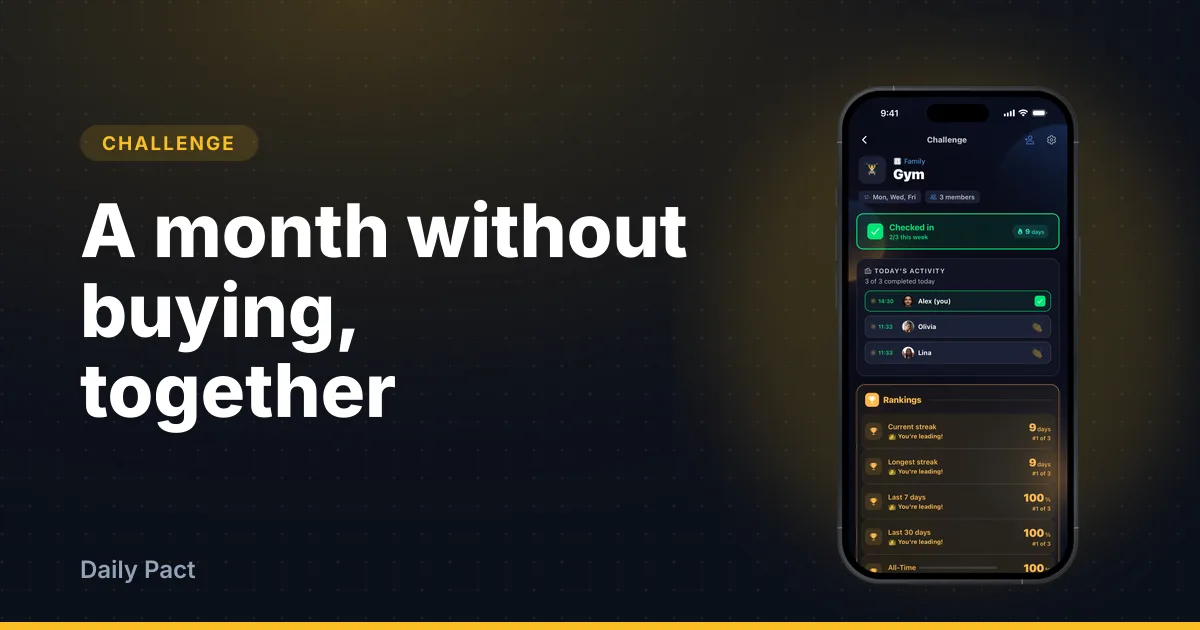
A no spend challenge is far easier when a friend or a small group does the same month and everyone checks in each day. You get someone to text instead of opening an online store, ideas for free weekends, and a small reason not to break the streak in front of people who are keeping theirs.
WalletHub lists doing it with a friend as one of its main tips for motivation, and it works for the same reason any accountability partner does: a private rule is easy to bend on a tired evening, a shared one isn't. In Daily Pact's own app data, habits shared with one or two friends got 5.9 check-in days in the first month, against 1.7 for habits done alone (Daily Pact app data (Mar-Oct 2026, 3,723 habits)). Different habits, same pattern: people keep going when someone else can see.
How to set it up as a group:
- Same start date, same rules. Post the three lists in the chat on day 0.
- One yes or no check-in a day. "No nonessential purchase today: yes." No receipts, no amounts.
- Keep the money private. Share days, not balances. People drop out when it turns into comparing incomes.
- A small shared goal. A cheap dinner together at the end, paid with what you saved, is better than any prize.
If you don't have someone in mind, how to find an accountability partner lists places that work, and an accountabilibuddy can be a coworker who wants to save for the same reason.
Your no spend challenge tracker
Mark one box per day: a check for a day with no nonessential purchase, an E for an essential-only exception, and nothing for a slip. Copy this into a note or the group chat and update it every evening.
| Week | Mon | Tue | Wed | Thu | Fri | Sat | Sun | Saved |
|---|---|---|---|---|---|---|---|---|
| 1 | ||||||||
| 2 | ||||||||
| 3 | ||||||||
| 4 |
Two tips that make the tracker work: check in at the same time every day (after dinner works for most people), and write the "saved" amount only once a week, so the daily check-in stays quick.
No spend challenge ideas: free things to do instead
Replace the spending with something free you'd actually look forward to, planned before the weekend, not on the spot. An empty Saturday is where most challenges break.
- At home: a pantry challenge (cook only from what you have), a movie night with what you already stream, a board game evening, a closet clear-out.
- Outside: a long walk or hike, a free museum day, the library, a park run, a community event.
- With friends: a potluck instead of a restaurant, a skill swap, a fun challenge to do together that costs nothing.
- For yourself: start a habit you've been putting off, like a daily challenge of 20 minutes of reading or a walk after dinner.
After the challenge: keep what worked
Keep two or three rules from the challenge instead of going back to how you spent before. The most common ones people keep are no takeout on weekdays, a list for every grocery trip, and a 48-hour wait before any purchase over a set amount.
Move the money you didn't spend right away, before it gets spent on something else. Fidelity suggests putting it toward emergency savings, high-interest card debt or a short-term goal, with an automatic transfer so the habit continues (Fidelity). Then, if the month went well, pick the next challenge with the same group: a no sugar challenge, a 30-day no alcohol challenge, or one of these 30-day challenges for groups.
Frequently asked questions
What are the rules of a no spend challenge?
Pay only for essentials (housing, bills, groceries from a list, transportation, health care, minimum debt payments) and buy nothing discretionary for the set period. Write the rules down before day one, allow real emergencies, and mark every no-spend day.
What is a no-spend month?
A no-spend month is a 30-day no spend challenge: one month without takeout, shopping, new subscriptions or other nonessential purchases, while essentials are still paid. It is the most popular length because it is long enough to change habits and short enough to finish.
Are groceries allowed in a no spend challenge?
Yes. Groceries are an essential, so most versions allow them, but only from a written list. Snacks, drinks bought out and extras that aren't on the list count as spending.
What are the rules for a no spend week?
The same as a month, for seven days: essentials only, no takeout, no shopping, no new subscriptions. Plan the weekend in advance with free things to do, because that is where most no spend weeks break.
Is a no spend challenge easier with friends?
For most people, yes. A friend doing the same month gives you someone to text instead of buying, ideas for free weekends, and a daily check-in you don't want to miss. Share the days you kept the rules, not the amounts.