
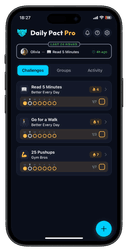
Try Daily Pact free for 14 days
Group challenges, leaderboards & streak tracking with your friends. No credit card required.
A daily challenge is a single thing you do every day for a set period. That's it — and the simplicity is the point. Weekly goals let four bad days pass before anyone notices. Daily ones don't give the drift room to start.
Below are 60 ideas grouped by area, sorted within each group from easiest to hardest to sustain. Then the part that actually matters: the three rules that decide whether you're still doing it in week three.
Pick for your worst day, not your best
Almost everyone chooses a daily challenge on a Sunday evening, feeling motivated, and calibrates it to that mood. Then Wednesday arrives — you slept badly, work overran, and the challenge you designed for Sunday-you is now impossible.
The fix is to pick something you could complete on your worst realistic day. A daily challenge you keep at 60% intensity beats an ambitious one you abandon on day nine, because the thing you're actually building is the streak, not the workout.
Fitness and movement
- 20 minutes outside — walking counts
- 30 press-ups, split however you like
- Take the stairs, every time, all day
- 10 minutes of stretching before bed
- 8,000 steps
- A 5-minute plank routine
- 50 squats across the day
- Cycle or walk one journey you'd normally drive
- 20 minutes of any deliberate training
- Morning mobility before you look at your phone
- Run 2km
- A full workout session
Mind and focus
- Read 10 pages
- Write three sentences in a journal
- 10 minutes of quiet with no input
- Learn five words in a language
- No phone for the first 20 minutes after waking
- One hour with notifications off
- Write down tomorrow's three priorities before bed
- Read 25 pages
- 20 minutes of focused practice on one skill
- No social media before noon
- Write 500 words
- Phone in another room after 9pm
Health and food
- A glass of water before coffee
- Two litres of water
- Eat one vegetable at every meal
- No snacks after dinner
- Cook one meal from scratch
- In bed by a fixed time
- Protein at breakfast
- No alcohol
- No takeaway
- Track everything you eat, without judging it
- No refined sugar
- Eight hours of sleep, actually enforced
Money and admin
- Log every purchase
- No unplanned spending
- Cancel one unused subscription
- Move a fixed amount to savings
- Deal with one item from the list you're avoiding
- Inbox to zero
- No spending at all
- Review your accounts for 10 minutes
- Sell or give away one thing you don't use
- Ten minutes on the admin task you've been postponing
Home and space
- Make your bed
- Ten-minute tidy before bed
- Wash up before sleeping — no exceptions
- One surface fully cleared
- Throw away or donate one item
- Twenty minutes on one room
People
- Message someone you've been meaning to contact
- Say one specific thank-you
- Ask someone a question and don't talk about yourself
- Call, don't text
- Write a note to someone who'd be surprised to get one
- Have one conversation with no phone present
- Give one genuine compliment
- Reconnect with one person you've lost touch with
The three rules that decide whether this lasts
Make it binary. At the end of the day the answer must be yes or no. "Read 10 pages" works. "Read more" doesn't, because on a bad day you'll negotiate with yourself and win.
Decide what a missed day means before you miss one. This matters more than the challenge you pick. Most people treat one miss as proof the attempt has failed, and quit rather than restart at day one. Agree in advance — with yourself or your group — that a miss costs you the day and nothing more. Groups that skip this step reliably fall apart in week two.
Make someone else able to see it. A challenge nobody can observe is a promise you can quietly renegotiate. This is the whole mechanism behind accountability partners and it applies just as much to a daily challenge as to a goal — when the report is visible, skipping stops being free.
Doing it with other people
Daily challenges are markedly easier to keep with a few other people doing the same one. Not for encouragement — for the much simpler reason that someone notices.
You can run this from a group chat, and plenty do. It works for about a week: check-ins get quieter, one person goes silent, everyone else takes it as permission, and it ends without anyone saying so. That specific failure is why we built Daily Pact — a private group, a shared daily challenge, one-tap check-in, and a leaderboard so being behind is visible without anyone having to bring it up.
Want a longer commitment instead? See 30-day challenge ideas, or self care challenges if you want the version aimed at how you feel rather than what you achieve.

Ready to build habits with friends?
Start your 14-day free trial — no credit card required.