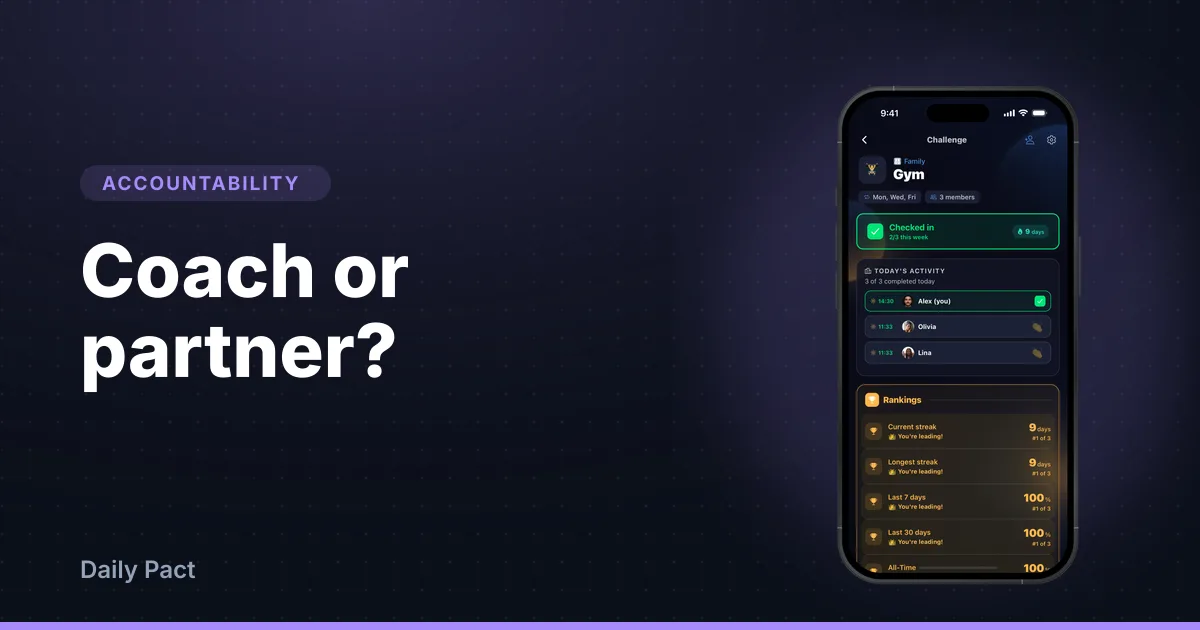
Accountability coach vs accountability partner comes down to money and direction: an accountability coach is someone you pay to check whether you did what you said, while an accountability partner is a peer (often a friend) who does the same thing for free, usually while working on a goal of their own. The paid version adds reliability, not magic: a coach shows up every day because it's their job, follows a method, and doesn't need you to hold them accountable back.

Ready to build habits with friends?
Start your 14-day free trial. No credit card required.
That is the honest answer to the question people actually type into Google: "a roommate could check in once a week for free, so what is the paid version adding?" For a lot of people, the answer is "nothing they need yet". For some, it's the one thing that finally works. This guide shows what each one does, what coaching costs right now, and a simple way to decide.
Accountability coach vs accountability partner: the difference
A coach is paid, one-directional and consistent. A partner is free, mutual and only as consistent as the two of you. Both do the core job: you say what you'll do, someone notices whether you did it. The difference is who carries the effort of noticing, and what happens on the day neither of you feels like it.
| Accountability coach | Accountability partner | |
|---|---|---|
| Cost | About $25 to $199+ a month (see below) | Free, or a shared app |
| Who it's about | Only you | Both of you |
| Check-ins | Daily or weekly, on a schedule they keep | Whatever you agree, and whatever survives week two |
| Method | Goal setting, planning, proof, feedback | Usually none, unless you write one down |
| What breaks it | You stop paying | One of you goes quiet |
| Best for | Work and business goals, people who've outlasted every peer partner | Daily habits, fitness, shared challenges, anyone starting out |
A partner also gets something a coach doesn't: their own goal moves too. That two-way pressure is the reason pairs work. You don't want to be the one who broke the streak.
What does an accountability coach actually do?
An accountability coach turns a goal into small weekly or daily commitments, checks in on each one, asks for proof or a report, and gives feedback when you miss. Most also run a planning call at the start and a review call every week or month. The check-ins happen by chat, text, WhatsApp or email; the calls by video.
Three real services show the range (prices from their own pricing pages, checked November 2026):
- Boss as a Service: a real person checks in morning and evening, Monday to Saturday, by text, WhatsApp, email or Telegram, and only tasks you can prove (a screenshot, a photo, a link) count as done. From $25 a month, or about $17 a month billed yearly.
- GoalsWon: a dedicated human coach reads your daily check-in by chat and replies personally every day, with a monthly video call. $90 a month, or $720 a year ($60 a month), with a free trial.
- Commit Action: aimed at entrepreneurs, a 60-minute goal planning call, then a 20-minute 1-to-1 call every week and unlimited SMS and WhatsApp check-ins. $199 a month ($160 billed yearly), with business tiers from $575 a month.
So "accountability coaching" covers everything from a daily text nudge to weekly business strategy calls. Before you pay, know which of those you're buying.
How much does an accountability coach cost?
Expect about $25 a month for a check-in service, around $60 to $90 a month for a daily coach with a monthly call, and $199 a month or more for weekly 1-to-1 calls. Independent life and business coaches who sell accountability as part of coaching usually charge more, often several hundred dollars a month, because you're paying for their time on calls.
What drives the price is almost always live human time: a text reply costs a coach a minute, a weekly call costs them half an hour plus preparation. If your problem is "I don't do the thing", you rarely need the expensive part. If your problem is "I don't know what the thing should be", a coach's planning time is the part that's worth paying for.
Is an accountability coach worth it?
An accountability coach is worth it when you've tried free accountability and it failed for a reason money fixes: nobody reliable to ask, a goal no friend understands, or a habit of talking peers out of holding you to it. It's not worth it when you haven't yet tried a partner with a clear daily rule, which is where most people should start.
A coach is a good buy if:
- Your goal is work or business (shipping a product, finishing a thesis, client outreach) and no friend has the context to push back.
- You've had partners and you charm them. A coach who asks for a screenshot doesn't accept "it's been a crazy week".
- You need a plan, not just a witness. The planning calls are real value if you don't know what to do each week.
- You'll take it more seriously because it costs money. Some people only show up for things they pay for. Be honest about whether that's you.
Skip it, for now, if:
- The goal is a daily habit (a workout, a walk, reading, no sugar). A one-tap check-in with a friend does the noticing every day, and a coach doing it at $90 a month is mostly a very expensive notification.
- You've never tried a partner with a written rule. Most partnerships fail because nobody agreed what counts, when to check in and what happens after a miss. Our accountability partner agreement fixes that in ten minutes.
- You want company, not supervision. Doing a challenge with someone is a different motivation from reporting to someone, and for fitness and habits it's usually the stronger one.
Why a free partner works better than people expect
The data says a partner alone makes a big difference. In the Daily Pact Habits Report 2026 (4,404 habits), habits shared with one or two friends got 6.6 check-in days in the first month, against 1.5 for habits done alone, and 89% of habits started with others got a check-in in their first week, against 43% started alone.
Group size matters too: 26.4% of habits shared by exactly three people were still active in week 4, against 12.7% for pairs and 3.1% for people alone.
Alone
3.1%
2 people
12.7%
3 people
26.4%
4-5 people
10.9%
6 or more
3.1%
Source: The Daily Pact Habits Report 2026.
See the numbers+
| People | Habits (n) | Alive in week 4 | Check-in days, month 1 |
|---|---|---|---|
| Alone | 1,615 | 3.1% | 1.5 |
| 2 people | 766 | 12.7% | 5.4 |
| 3 people | 444 | 26.4% | 8.9 |
| 4-5 people | 236 | 10.9% | 4.7 |
| 6 or more | 1,343 | 3.1% | 4.8 |
That gap is what a coach charges for: someone who expects you to show up tomorrow. A friend can do it for nothing, as long as the setup makes it effortless. The things that make a peer partnership last are the same things a coach builds in:
- One specific daily rule. "20 minutes of walking", not "be healthier".
- A check-in you both see, not a weekly "how's it going?" text that nobody sends by week three.
- A plan for misses. Decide in advance what a sick day means, so one bad day doesn't end it. (More on the never miss twice rule.)
- A short first run. Thirty days, then decide together whether to keep going.
More on choosing the right person, and the numbers behind it, on our accountability partner page.
Accountability coach app or partner app: what to use
For a coach, use the coach's own app or chat (GoalsWon and Boss as a Service run their own). For a partner, use a shared check-in app where both of you can see each other's day, because chat threads go quiet. You don't need both, and you don't need an app that pretends to be a coach.
- Paid human coaching: GoalsWon, Boss as a Service, Commit Action. Compared in our GoalsWon alternatives guide.
- An AI check-in: cheaper and always available, but easy to ignore. See AI accountability partner for what it does and doesn't do.
- A friend or a small group: Daily Pact, or any of the apps in best accountability apps.
- No friend to ask yet: seven places to find an accountability partner online, from matched cohorts to body-doubling sessions.
A simple way to decide
Start with a partner for 30 days. If it fails because of the person, try a different partner or a small group of three. If it fails because of the goal (you don't know what to do each week), that's when a coach earns their fee.
- Week 0: write one daily rule and ask one friend to do it with you. Agree the check-in and what happens after a miss.
- Days 1 to 30: check in every day where you both see it.
- Day 30: still going? Keep it, and you've saved yourself a coaching bill. Stopped? Ask why honestly. The wrong person, try again with someone else or a small accountability group. The wrong plan, book a coach for the planning part.
Frequently asked questions
What is the difference between an accountability coach and an accountability partner?
A coach is paid, checks in on you on a fixed schedule and usually adds planning calls and feedback. A partner is a peer who does it for free, usually while working on a goal of their own, so the accountability goes both ways.
How much does an accountability coach cost?
As of November 2026, about $25 a month for a check-in service like Boss as a Service, $90 a month for GoalsWon's daily coach, and $199 a month for Commit Action's weekly calls. Independent coaches often charge several hundred dollars a month.
Is an accountability coach worth it?
Yes if free accountability already failed for a reason money fixes, such as no reliable peer or a work goal nobody else understands. For a daily habit, try a partner with a clear daily rule first: it costs nothing and often works.
Can a friend be your accountability coach?
A friend can do the checking part for free. What they rarely do is keep it up when it's one-way, so make it mutual: pick a goal each, check in daily where you both see it, and agree what happens after a miss.
Is there an app for an accountability partner instead of a coach?
Yes. Shared check-in apps like Daily Pact let you and a partner or a small group tap once a day and see who showed up. See best accountability apps for more options.
Ready to build habits with friends?
Start your 14-day free trial. No credit card required.