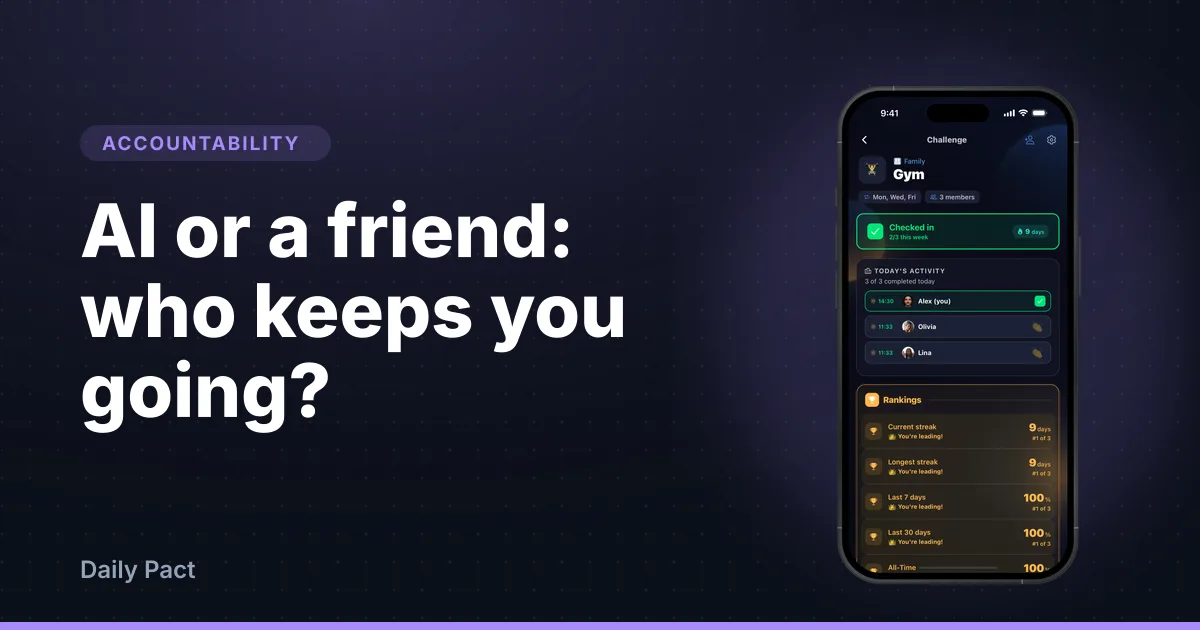
An AI accountability partner is a chatbot or app (ChatGPT, Gemini or a dedicated AI coach) that helps you set goals, checks in on you and reminds you what you promised. It is very good at planning and never gets tired of you, but it can't be let down, and that is the part of accountability that keeps most people going: the best setup is AI for the plan, a real person for the check-ins.

Ready to build habits with friends?
Start your 14-day free trial. No credit card required.
This guide covers what an AI accountability partner does well, where it falls short, what the research says about chatbots and about human accountability, and a simple way to combine the two.
What is an AI accountability partner?
An AI accountability partner is software that plays the role a friend or coach normally plays: you tell it your goal, it helps you break it into steps, asks how it went, and reminds you to do it. Some people use a general chatbot like ChatGPT this way; others use apps built for it, some of which message or even phone you every day.
There are three common setups:
| Setup | How it works | Good for | The catch |
|---|---|---|---|
| A general chatbot (ChatGPT, Gemini, Claude) | You open a chat, share your goal and report back when you remember | Planning, breaking big goals into steps, talking through a bad week | Nothing happens if you stop opening the chat |
| A dedicated AI accountability app | It messages, emails or calls you on a schedule and asks about progress | Consistent prompts without you starting them | You can ignore or snooze it with zero social cost |
| A human partner or group, with an app | Friends commit to the same habit and see each other's check-ins | Showing up on the days you don't feel like it | You have to find and ask a real person |
Does an AI accountability partner work?
It can help a bit. A 2023 meta-analysis of 19 chatbot trials with 3,567 people found chatbots raised physical activity by about 735 steps a day and 103 minutes of moderate-to-vigorous activity a week. But 74% of those trials were rated low quality, and chatbots worked better as part of a wider program than alone (Singh et al., npj Digital Medicine, 2023).
So an AI coach is not useless. It is a good planner, it is available at 11pm, and it never judges you. The honest summary of the evidence is: a modest effect, mostly in short studies, and stronger when a chatbot is one part of a program rather than the whole thing.
Where it helps most:
- Turning a vague goal into a plan. "Get fit" becomes "walk 20 minutes after lunch, Monday to Friday, for 30 days".
- Shrinking a goal after a bad week, instead of quitting it.
- Thinking out loud about why you keep skipping, without feeling judged.
- Drafting the message you send to a friend to ask them to be your partner.
Why a real person still beats AI for accountability
Accountability works because someone else will notice. In a Dominican University study of 149 people, those who sent weekly progress reports to a supportive friend scored 7.6 on goal achievement after four weeks, against 4.28 for people who only thought about their goals. Writing goals down helped too, but reporting to a person helped most (Matthews, Dominican University of California).
A chatbot can ask the same question a friend asks. What it can't do is be disappointed, proud or waiting for you. Three things a person brings that software doesn't:
- Social cost. Skipping in front of a friend feels different from dismissing a notification. That small sting is the mechanism.
- Shared stakes. When a friend is doing the same habit, your check-in is also their motivation. Researchers call the effect of not wanting to be the weak link of a team the Köhler effect.
- Real reactions. A thumbs-up from a person who knows you matters more than an automatic "Great job!".
Our own app data shows the reaction part clearly. Shared habits where a friend reacted to a check-in in the first week were still going in week 4 in 33.3% of cases, against 7.2% without a reaction (Daily Pact Habits Report 2026 (4,404 habits)). That is association, not proof, but the gap is large.
7.2%
no reaction
33.3%
a friend reacted
4.9 days
no reaction
11 days
a friend reacted
n = 357 shared habits with a reaction in week 1, 2,432 without. Source: The Daily Pact Habits Report 2026.
Are reminders enough?
Not on their own. In our app data, habits with a reminder set were still active in week 4 in 7.9% of cases, against 7.7% without one: practically no difference. A reminder tells you it's time. It doesn't make you want to do it, and that is the gap most AI accountability apps try to fill with more messages.
This matters when you choose an AI partner, because much of what an AI coach does is a smarter reminder. Prompts are useful for remembering. For following through, what moved the numbers in our data was other people: habits shared with 1-2 friends got 6.6 check-in days in their first month, against 1.5 for habits done alone (Daily Pact Habits Report 2026).
If you want the full picture of why partners work and how to pick one, see our data page on accountability partners.
AI vs human accountability partner: which should you pick?
Pick AI if you mainly need a plan and a nudge, have nobody to ask yet, or want privacy for a goal you're not ready to share. Pick a person, or a small group, if you've started the same goal before and quit within two weeks. Most people who search for an AI partner fall in the second group.
| AI accountability partner | Human accountability partner | |
|---|---|---|
| Available | Any time, instantly | When they reply |
| Planning help | Excellent | Depends on the person |
| Cost of skipping | None | You let someone down |
| Shared goal | No | Yes, if they do it too |
| Notices a pattern | Only what you tell it | Sees your actual check-ins |
| Privacy | High | You share your progress |
| Best for | Starting, planning, reflecting | Showing up for weeks |
A group of three did best in our data: 26.4% of habits shared by exactly three people were still active in week 4, against 12.7% for pairs and 3.1% alone. Three is small enough to feel personal and big enough that one person's bad week doesn't end it.
How to combine AI and a real accountability partner
Use AI to build the plan and a person to keep it. Ask a chatbot to turn your goal into one small daily action, then make that action a shared pact with one or two friends who check in every day. The AI handles the thinking; the people handle the showing up.
A setup that takes ten minutes:
- Plan with AI. Ask: "Turn my goal of X into one daily action I can do in under 15 minutes, and a worst-day version." Keep the answer short.
- Pick one or two people. A friend who wants the same thing, a coworker, a sibling. If nobody nearby fits, here is how to find an accountability partner online.
- Agree the rules. Daily check-in by 10pm, what counts as done, what happens after a missed day. Our accountability partner agreement has a template.
- Check in where you all see it. One shared place, not a private chat with a bot.
- Review weekly with AI if you like. Paste in your week and ask what to change. Then tell your partner what you changed.
For other apps built around friends rather than bots, see our roundup of the best accountability apps and the accountability apps for friends that also track habits.
Can ChatGPT be your accountability partner?
ChatGPT can act as an accountability coach if you set it up: tell it your goal, ask it to plan with you, and come back every evening to report. The weakness is that you have to start every conversation, so on the day you're avoiding the habit, you're also avoiding the chat.
A prompt that works better than "be my accountability partner":
"My goal is to read 20 pages a day for 30 days. Each time I report, ask what got in the way, suggest one change, and keep my streak count. Be direct, not cheerful."
Then add one human. Send your friend the same plan and agree that you both check in daily. If you want ideas for what to do together, our list of accountability group ideas and the guide on how to hold yourself accountable are good next reads.
Frequently asked questions
What is an AI accountability partner?
A chatbot or app that helps you set goals, asks about your progress and reminds you what you committed to. It can be a general chatbot like ChatGPT or an app built for it that messages or calls you on a schedule.
Is an AI accountability partner better than a human one?
For planning, yes: it is always available and never judges. For following through, a person usually wins, because skipping in front of someone has a social cost. In a Dominican University study, people who sent weekly progress reports to a friend achieved the most.
Is there an app that holds you accountable?
Yes. AI coaching apps prompt you on a schedule, and social apps like Daily Pact let friends see whether you checked in each day. See our list of the best accountability apps.
Can ChatGPT hold me accountable?
Partly. It can plan with you and track what you report, but it only knows what you tell it and it can't notice when you stop showing up. Pair it with a friend who checks in on the same habit.
What makes a good accountability partner?
Someone who wants a similar goal, will check in on a fixed schedule, and is honest when you slip. A group of three tends to last longer than a pair. More in our guide to accountability partners.
Ready to build habits with friends?
Start your 14-day free trial. No credit card required.