The short answer

Daily Pact
Our pick★ 5.0 on the App StoreFor a friend group with different sports, devices and schedules.
Daily Pact turns "gym 3 times a week" into one challenge for the whole group. Everyone taps when they've trained, the leaderboard ranks the group, and PactPause covers an injury or a holiday. No wearable needed, iPhone and Android. 14 days free with everything, then $0.99 a month.

If that doesn't fit you
- It's you and one gym partner, both on iPhone: Sweatmates adds photo proof and wagers.
- Everyone runs or rides outdoors: Strava's free clubs and challenges.
- You want a step challenge with real step counts: Stridekick syncs every wearable.
- Your group is all iPhone and wants custom scoring: GymRats.
- Nobody will hold you to it: FineStreak calls you and, if you opt in, fines you.
Quick comparison
| App | Groups | Auto-tracks | Leaderboard | Rest-week safe | Price | Platforms |
|---|---|---|---|---|---|---|
 Daily PactOur pickFriend groups, manual check-in Daily PactOur pickFriend groups, manual check-in | $0.99/mo after trial | iOS · Android | ||||
| SweatmatesPairs, photo check-ins | Free / Pro from $4.99 | iOS | ||||
| GymRatsGroup challenges, photo posts | Free / $3.99/mo | iOS | ||||
| StravaAutomatic GPS tracking | Free / $11.99/mo | iOS · Android · Web | ||||
| StridekickStep challenges, device sync | Free / from $12.99/mo | iOS · Android | ||||
| Squad1–4 week challenges | Free with friends | iOS · Android | ||||
| Habit HuddleCommunity huddles | Free / from $8/mo | Web · iOS · Android · Discord | ||||
| FineStreakSolo, AI check-ins, optional fines | $8–20/mo | Web |
Prices are US storefront, checked 10 September 2026. "Auto-tracks" means the app records the workout itself; "rest-week safe" means a built-in way to skip a week without losing your streak.
How we chose
We build Daily Pact, so read our pick with that in mind. Every app here was judged on the same questions: who notices when you skip, how fast the check-in is, what happens after a missed day, and what it really costs. We say plainly where another app does something we don't. The full policy is on our About page.

1. Daily Pact
Our pickGym, run or home workout — one tap when it's done
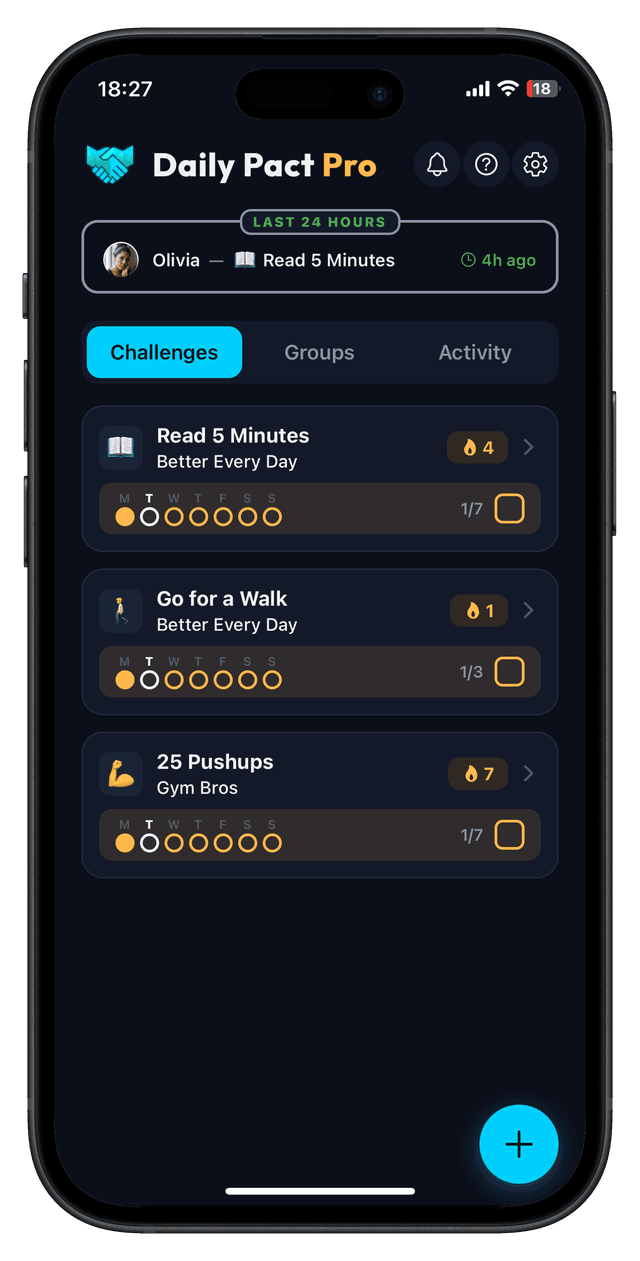
Daily Pact doesn't count your reps or read your heart rate. You set a challenge — "gym 3 times a week", "run every morning", "10,000 steps" — invite your friends into a private group, and everyone taps once when they've done it. The leaderboard ranks the group by completion, notifications tell you when a friend has trained, and PactPause covers an injury or a holiday without ending the streak. Because there is no device to sync, it works for a group where one person has a Garmin, one an Apple Watch and one nothing at all. Weekly challenges ("3 times this week") are the right shape for training.


New accounts get 14 days free · No credit card
Pros
- Rated 5.0 on the App Store
- Weekly targets: "gym 3× a week" is one challenge
- Works with any wearable or none
- Leaderboard and notifications for the group
- PactPause for injuries and travel
- Groups up to 50 — a whole running club fits
Cons
- No automatic tracking — it trusts the tap
- No free tier after the 14-day trial
- No web version
2. Sweatmates
Partner accountability with photo proof and wagers
Sweatmates is for two people. Each sets a weekly workout goal and logs sessions with a photo from its "SweatCam" — the gym, a sweaty selfie, a screenshot. You can wager on missed goals, appeal with a "Pinky Promise", and nudge each other. With more than 10,000 App Store ratings at 4.9 it's clearly working for a lot of pairs. iPhone only.
Pros
- Photo proof
- Wagers and nudges
- Weekly awards
- Large, happy user base
Cons
- Pairs only — no groups
- iPhone only
- Pro subscription from $4.99
3. GymRats
Group challenges scored however you like
GymRats runs group fitness challenges where everyone posts a workout with a photo and a title, and the group scores it — by number of workouts, minutes, miles, calories, steps or a custom point system. That flexibility is its strength: a group of runners and lifters can compete on the same board. 4.9 from 4,600 ratings. Pro is $3.99 a month or $32.99 a year. iPhone only, which rules out mixed groups.
Pros
- Custom scoring — workouts, minutes, miles, your own points
- Photo posts keep it honest
- Cheap Pro tier
Cons
- iPhone only
- Photo per workout is more friction than a tap
- No streak protection
4. Strava
GPS tracking with clubs and challenges
Strava records runs, rides and walks by GPS, and the free version includes clubs, kudos, comments and challenges. The accountability is the feed: your friends see the activity, or the absence of one. It's the best option if your training is measurable outdoors, and useless for the gym, yoga or anything without a route. A subscription ($11.99 a month or $79.99 a year, 30-day trial) adds analysis and segment features.
Pros
- Automatic, accurate tracking of runs and rides
- Clubs and challenges are free
- Everyone's already on it
Cons
- Only for GPS activities
- The feed is easy to ignore
- Subscription $11.99/mo for the analysis
5. Stridekick
Step challenges across any device
Stridekick pulls steps from Fitbit, Apple Watch, iPhone, Android, Garmin, Withings, WHOOP and Oura and runs challenges on them: leaderboards, targets, virtual races, streaks. The free plan covers public challenges of up to 10 people for up to 7 days. Private or longer challenges need a Pro plan, which the organiser pays: $12.99 a month for 10 people, $24.99 for 20, $49.99 for 50.
Pros
- Syncs every major wearable
- Five challenge modes
- Corporate tier for big groups
Cons
- Free tier is public, 7 days, 10 people
- Pro from $12.99/mo
- Steps only
6. Squad
A 21-day workout sprint with stakes
Squad runs time-boxed challenges with a daily check-in. Private squads with friends are free; public squads use credits, and you lose one when you miss. Good for a fixed block like "train every day for 21 days"; not built for the ongoing "3 times a week" rhythm.
Pros
- Free with friends
- Stakes if you want them
- Both platforms
Cons
- Ends after four weeks
- No leaderboard
- Daily, not weekly, targets
7. Habit Huddle
A fitness huddle with seasons
Habit Huddle's public and private huddles work for training as for any habit: individual streaks, a shared group streak, monthly seasons and leaderboards, streak freezes for rest weeks. Free tier; paid from $8 a month.
Pros
- Free tier
- Streak freezes for rest weeks
- Web app
Cons
- Paid tiers from $8/mo
- Feature-heavy
- Small community
8. FineStreak
An AI agent that fines you for skipping
FineStreak calls or texts you at your chosen time, asks whether you trained, and at the stricter tiers wants a photo or a live check. Fines are off by default; on, they run from ten cents to $50 a miss. No friends involved. From $8 a month (Founding $5 for the first 100), browser only for now.
Pros
- Works with no training partner
- Verification you can't fake
- Fines optional
Cons
- No free tier
- Web only
- Not social
Check-in apps versus tracking apps
Workout apps split into two families, and the split matters more than any feature list.
- Tracking apps (Strava, Stridekick, Apple Fitness) measure the workout. They are accurate and effortless, and they only work for what they can measure: GPS routes, steps, watch-detected exercise. A yoga class, a climbing session or a home workout with no watch doesn't register.
- Check-in apps (Daily Pact, Sweatmates, GymRats, Squad) trust you to tap or post a photo. They work for any kind of training and for mixed groups with different devices. They can be gamed, which is why the group matters: you're not lying to an app, you're lying to your friends.
For a friend group, the check-in model usually wins, because the point isn't the data, it's that someone notices when you skip. For a running club that already lives on Strava, stay on Strava.
Gym partner or gym group?
One partner is stronger accountability than five friends, right up until the partner gets injured or busy, at which point you have nothing. A group of four to eight survives one person going quiet. Sweatmates and BuddyUp are built for the pair; Daily Pact, GymRats and Habit Huddle for the group. If you have both — a lifting partner and a wider circle — a group with a weekly target covers the partner case too.
12 workout challenges that work with friends
Each is a yes/no you can check in on. Weekly targets are marked; they are more forgiving than daily streaks and better suited to training.
- Gym 3 times a week (weekly)
- Run every morning for 30 days
- 10,000 steps a day
- 20 push-ups every day, add one a day
- A 5k a week (weekly)
- Stretch 10 minutes daily
- Home workout 4 times a week (weekly)
- No elevator for 30 days
- Walk or cycle to work 3 times a week (weekly)
- Plank every day, 30 seconds longer each week
- One long walk at the weekend (weekly)
- Complete the same 4-week programme together
For 25 more, with setup tips, see fitness challenges with friends.
Frequently Asked Questions
What is the best workout accountability app with friends?
Daily Pact, for a friend group that trains in different ways: set a weekly target like gym 3 times a week, check in with one tap, and see the group leaderboard. It works with any wearable or none. For two people who want photo proof and wagers, Sweatmates. For runners and cyclists, Strava's clubs.
Is there a free workout accountability app?
Strava, Sweatmates, GymRats and Habit Huddle all have free tiers. Squad is free for private squads with friends. Stridekick is free for public 7-day challenges. Daily Pact is free for 14 days with everything, then $0.99 a month.
Do I need an Apple Watch or Fitbit?
Only for the tracking apps. Strava needs GPS from a phone or watch; Stridekick needs a step source. Daily Pact, Sweatmates, GymRats and Squad work with a tap or a photo, so a group with mixed devices, or no devices, is fine.
What about Apple Fitness activity sharing?
If everyone in your group has an Apple Watch, the built-in Fitness app lets you share activity rings and run 7-day competitions, free. It's automatic and hard to fake. It doesn't work for Android friends, gym-only training the watch misses, or anything beyond a week.
Gym accountability app or just a group chat?
A group chat works for about two weeks. Then the photos stop, nobody wants to be the one asking, and the thread goes quiet. An app that shows a leaderboard and sends a notification when someone trains does the asking for you.
Related guides
Start a workout challenge with your friends — free for 14 days
Start your 14-day free trial — no credit card required.
5.0 from 12 App Store ratingsAvailable on iPhone & Android · 14 days free for new accounts