The short answer

Daily Pact
Our pick★ 5.0 on the App StoreIf your problem is consistency, not the next hour.
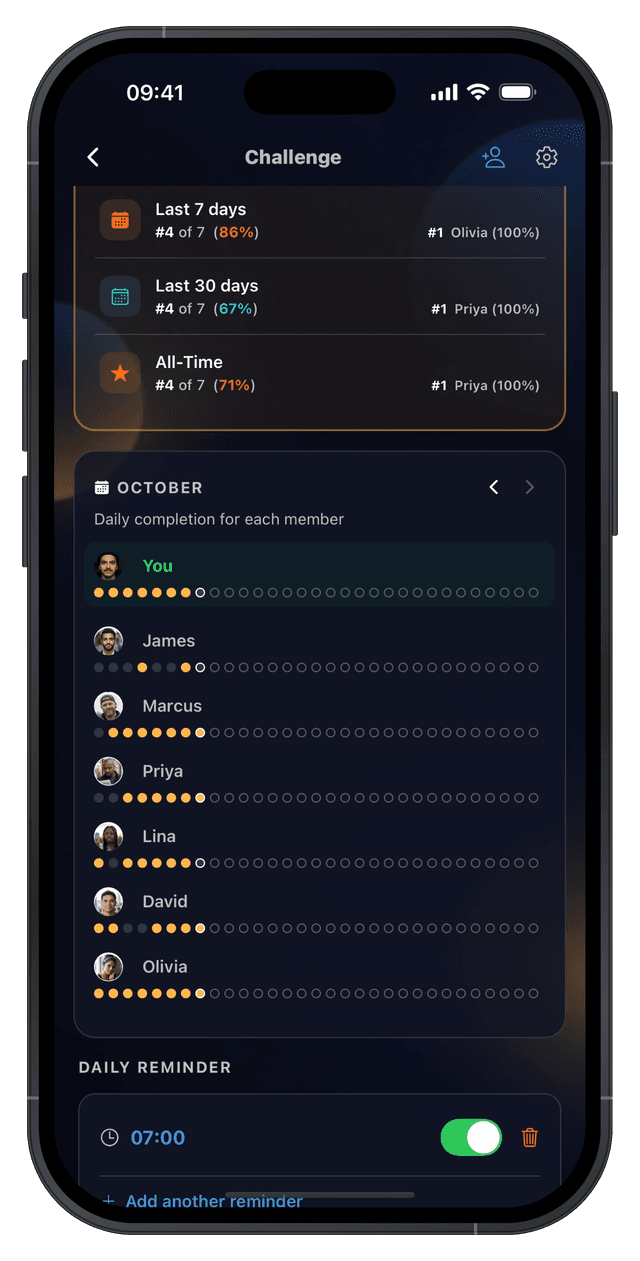
Daily Pact keeps a daily habit alive with friends or classmates: one-tap check-ins, a leaderboard, notifications when someone shows up, and PactPause for agreed breaks. No camera, no booking. iPhone and Android. 14 days free, then $0.99 a month.

If that doesn't fit you
Quick comparison
| App | Live video | Free tier | Daily habits | Phone app | Price | Platforms |
|---|---|---|---|---|---|---|
 Daily PactOur pickFriend groups, one-tap check-ins | $0.99/mo after trial | iOS · Android | ||||
| Flow ClubHosted group coworking | $40/mo | Computer | ||||
| CohortyMatched habit cohorts | Free | Web | ||||
| GoalsWonHuman accountability coach | $90/mo | iOS · Android · Web | ||||
| Focusmate1-on-1 video coworking | Free / $8/mo | Web |
Prices are US storefront, checked 21 October 2026.
How we chose
We build Daily Pact, so read our pick with that in mind. Every app here was judged on the same questions: who notices when you skip, how fast the check-in is, what happens after a missed day, and what it really costs. We say plainly where another app does something we don't. The full policy is on our About page.

1. Daily Pact
Our pickAccountability for the habit, not the hour
Focusmate is brilliant for the next 50 minutes. It doesn't know whether you showed up yesterday. Daily Pact covers the other side: the daily habit. You and a friend, a study group or a small team set a challenge such as "two hours of deep work before lunch" or "study 30 minutes a day", and everyone checks in with one tap. The leaderboard and notifications show who has shown up, friends can nudge, and PactPause lets you request a break the group votes to approve. No video, no booking. Many people use both: Focusmate for the session, Daily Pact for the streak.


New accounts get 14 days free · No credit card
Pros
- Rated 5.0 on the App Store
- Tracks the habit across days and weeks
- No camera, no scheduling
- Friends or classmates, not strangers
- iPhone and Android apps
Cons
- No live sessions or body doubling
- Needs people you know
- No free tier after the 14-day trial
2. Flow Club
Focusmate, as a small hosted group
Flow Club is the closest Focusmate alternative. Instead of one partner you join a session of up to 9 people led by a host from the community, and sessions run from 30 minutes to 3 hours, with 60 minutes the most popular. Video is encouraged but not required, and there are chat-only, non-verbal sessions for people who don't want to talk or be seen. It's $40 a month or $400 a year, with 50% off for full-time students and non-profit workers, and a free trial.
Pros
- A host keeps time and structure
- Camera optional, chat-only sessions
- Longer sessions, up to 3 hours
Cons
- $400 a year after the trial
- Work sessions, not habits
- Joined from a computer
3. Cohorty
Quiet company, with no camera
If what you like about Focusmate is working alongside strangers without talking, Cohorty does that for habits. You set your habit challenge, Cohorty matches you with people building the same kind of habit, and you log progress daily. Support is a simple applause rather than comments, and you can use a nickname. It frames habits around showing up for 66 days. Cohorty says it is free while it builds, with premium tools planned.
Pros
- Free right now
- No camera, no chat
- Strangers, so no friends needed
Cons
- No live sessions
- Light-touch support
- Runs on the web
4. GoalsWon
A human who checks in every day
Focusmate partners change every session; a GoalsWon coach stays with you. You set your daily goals, report back at the end of the day, and a trained human coach replies, every day of the week, with a monthly video call. It's the most expensive option here: $90 a month (7-day free trial) or $720 a year (14-day free trial).
Pros
- Same coach every day
- Feedback on your plan
- Not AI
Cons
- $720 a year or more
- No live coworking
- 1-on-1 only
5. Focusmate
For reference: the app you're comparing
Focusmate is virtual body doubling. You book a 25, 50 or 75-minute session, get matched with another member, say what you'll do, and work on camera together. It runs in the browser on desktop or mobile, syncs with your calendar, and lets you favorite partners you liked. Members come from 150+ countries, and Focusmate counts 12 million+ completed sessions. The free plan is 3 sessions a week; Plus is unlimited for $8 a month billed yearly or $12 monthly.
Pros
- 3 free sessions a week
- Instant start on a task
- Favorite partners
Cons
- Camera on, every session
- No habit tracking across days
- Booking a slot each time
What Focusmate does well
Focusmate is the best-known body doubling tool for a reason. Saying out loud what you'll do in the next 50 minutes, to a real person on camera, is one of the fastest ways to start a task you've been avoiding. It's flexible (25, 50 or 75 minutes), you can use it for almost anything you can do on camera, from email to cooking to at-home exercise, and the free plan is enough to try it properly.
The reasons people want a Focusmate alternative are specific: the camera, booking a slot every time, the price of unlimited sessions, or that a great session today doesn't help with consistency over weeks.
Sessions or habits: which problem do you have?
| Your problem | What helps | Try |
|---|---|---|
| Starting the task in front of you | A live session with someone | Focusmate, Flow Club |
| Hating the camera | Chat-only or no video at all | Flow Club chat-only, Cohorty, Daily Pact |
| Doing it every day for months | A daily check-in someone sees | Daily Pact, Cohorty |
| Knowing what to work on | Feedback on your plan | GoalsWon |
| Cost | Free or nearly free | Focusmate free plan, Cohorty, Daily Pact at $9.99/yr |
Who should pick what
You love body doubling but want a group: Flow Club.
You want company without being seen: Cohorty, or Flow Club's chat-only sessions.
You're a student with a study group: Daily Pact. Set a daily study challenge for the group and let the leaderboard keep everyone honest. Our guide to accountability apps for students has more options.
You want someone to plan with you: GoalsWon, or see our GoalsWon alternatives for cheaper ways to get similar follow-up.
You're happy with three sessions a week: keep Focusmate's free plan and add a daily habit check-in on the other days.
If you want a wider view, the accountability apps roundup compares eleven options, and the Cohorty alternatives page covers more ways to be matched with strangers.
Combining a session app with a habit app
A setup that works for many people has two layers. A session tool gets you started on a hard day. A daily check-in with a friend keeps the habit alive between sessions. Pick a small, specific habit ("one 50-minute focus block before noon"), find one person to do it with, and check in daily. Our guide to finding an accountabilibuddy covers who to ask, and our list of free habit tracker apps with friends shows the no-cost options for the second layer.
Frequently Asked Questions
Is there a free alternative to Focusmate?
Focusmate itself has a free plan with 3 sessions a week. Cohorty is currently free and matches you with people building the same kind of habit, with no camera. Flow Club has a free trial. Daily Pact is free for 14 days, then $0.99 a month.
How much does Focusmate cost?
Focusmate's free plan includes 3 sessions a week. Plus gives you unlimited sessions for $8 a month billed annually, or $12 a month billed monthly.
What is the difference between Focusmate and Flow Club?
Focusmate pairs you 1-on-1 with another member for 25, 50 or 75 minutes, camera on. Flow Club runs hosted group sessions of up to 9 people, 30 minutes to 3 hours, with video optional. Focusmate has a free plan; Flow Club is $40 a month or $400 a year.
Is there a Focusmate alternative without a camera?
Yes. Flow Club has chat-only, non-verbal sessions. Cohorty and Daily Pact don't use video at all: you check in on your habit and other people see it.
Related guides
Try Daily Pact free for 14 days
Start your 14-day free trial. No credit card required.
5.0 from 12 App Store ratingsAvailable on iPhone & Android · 14 days free for new accounts