The short answer


If that doesn't fit you
Quick comparison
| App | Friends | Focus timer | Free tier | No friends needed | Price | Platforms |
|---|---|---|---|---|---|---|
 Daily PactOur pickFriend groups, daily check-in | $0.99/mo after trial | iOS · Android | ||||
| FocusmateBody doubling, 1-on-1 | Free / $8 to $12/mo | Web | ||||
| FloraFocus timer with friends | Free | iOS · Android | ||||
| ForestFocus timer | Free / $5.99/mo | iOS · Android · Watch | ||||
| CohortyMatched cohorts | Free | Web · iOS | ||||
| HabiticaRPG, solo or parties | Free / $4.99/mo | Web · iOS · Android |
Prices are US storefront, checked 10 September 2026.
How we chose
We build Daily Pact, so read our pick with that in mind. Every app here was judged on the same questions: who notices when you skip, how fast the check-in is, what happens after a missed day, and what it really costs. We say plainly where another app does something we don't. The full policy is on our About page.

1. Daily Pact
Our pickA study challenge with your classmates
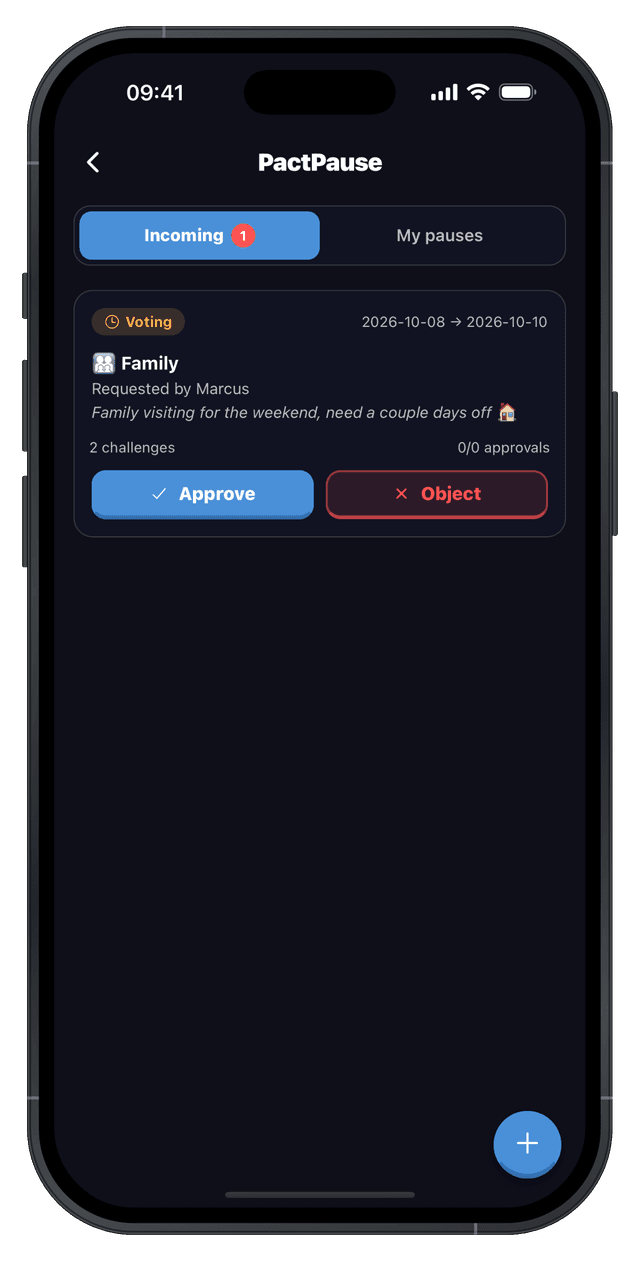
Daily Pact is for the habit around studying rather than the session itself: "two hours before 6pm", "read 30 pages", "no phone in the library", "revision every weekday". The simplest version is a study pact with one classmate: you both check in with one tap when it's done, and at 9pm you can see whether they did their two hours, and they can see yours. If one of you hasn't, the other can send a nudge, which is a lot easier than texting "so did you study?". It scales to a whole study group with a leaderboard. Weekly targets ("4 study days this week") fit a timetable better than daily streaks, and when exam week takes over everything else (or you go home for a long weekend) you ask the group for a PactPause, they approve it, and your streak survives. It's free for 14 days and 99 cents a month after, the price of a coffee a semester.


New accounts get 14 days free · No credit card
Pros
- Rated 5.0 on the App Store
- Works for reading, revision, assignments: any yes/no habit
- Weekly targets suit a timetable
- See when your study partner has checked in, and nudge them if they haven't
- PactPause for exam week or a trip home, approved by your group
- Cheap: $9.99 a year
Cons
- No timer or focus mode: it's a check-in
- No free tier after 14 days
- No web version
2. Focusmate
Study next to a stranger on video
Focusmate books you a 25, 50 or 75-minute video session with a stranger. You say what you'll do, work with the camera on, and report at the end. For getting a specific essay written it's remarkably effective: the other person's presence does the work. Three sessions a week are free with no card; unlimited is $8 a month billed yearly or $12 monthly. Browser only, which is fine for a laptop.
Pros
- Three free sessions a week
- Genuinely effective for deep work
- No friends required
Cons
- Strangers, on camera
- Not a habit tracker
- Unlimited is $8 to $12/mo
3. Flora
Plant a tree with friends; leave the app and it dies
Flora is a focus timer: start a session, a tree grows, and if you leave the app the tree dies. The friends part is real: you can plant together, so everyone's tree depends on everyone staying off their phone. It's free, with optional purchases that fund real tree planting. It's about the session, not the habit: it can't tell you whether you studied yesterday.
Pros
- Free
- Plant together with friends
- Real trees for the paid option
Cons
- Session-only, no habit history to speak of
- Punishes phone use, not skipping
- Kills the tree if you take a call
4. Forest
The original focus tree, with 'plant together'
Forest is Flora's better-known cousin, with a 4.8 from 49,000 ratings. Same idea: a tree grows while you focus. "Plant together" lets friends share a session, though reviewers note inviting friends is fiddly. Free with in-app purchases; the subscription is $5.99 a month or about $33 to $36 a year.
Pros
- Well established
- Apple Watch
- Plant together with friends
Cons
- Subscription $5.99/mo for the extras
- Friend invites are clunky
- Session-based, not habit-based
5. Cohorty
A study cohort of strangers, no chat
Cohorty matches you with 5 to 15 people on the same 7 to 30-day challenge ("study 2 hours daily") and shows everyone's check-ins as marks, with no obligation to talk. Free at the time of checking. Good if your friends won't commit, and quiet enough not to be another distraction.
Pros
- Free
- No friends needed
- No chat to get lost in
Cons
- Strangers
- No Android yet
- Ends with the challenge
6. Habitica
Homework as quests
Habitica turns assignments into to-dos and study habits into dailies that earn XP for your avatar. Parties with classmates add shared consequences. Free on every platform; the $4.99 subscription is cosmetic. Popular with students who like the game; a chore for those who don't.
Pros
- Free
- To-dos and habits in one place
- Parties with classmates
Cons
- Complex
- Easy to spend more time on the avatar than the essay
- No timer
Two different problems: sitting down, and staying down
Study apps solve one of two problems, and it helps to know which one you have.
- Sitting down. You don't start. The fix is a check-in that someone else sees: a study group in Daily Pact, a cohort in Cohorty, a party in Habitica. The question these answer is "did you study today?", and the answer is better when it reaches someone: in Daily Pact your study partner gets a notification when you check in, so skipping a day is something a classmate notices, not just you.
- Staying down. You start, then the phone wins. The fix is a session tool: Focusmate's stranger on camera, Flora or Forest's tree. The question these answer is "are you focused right now?"
Many students run one of each: a check-in app for the daily habit, a timer for the session. Neither replaces the other.
12 study challenges to run with classmates
Each is a yes/no you can check in on. Weekly targets are marked; they survive a timetable better than daily streaks.
- Two hours of study before 6pm
- Read 30 pages a day
- Revision every weekday (weekly: 5)
- Phone in another room for the first hour
- One past paper a week (weekly)
- Flashcards for 15 minutes daily
- Library by 9am, 4 days a week (weekly)
- No social media until the day's work is done
- Write 300 words a day on the dissertation
- Sleep by midnight during term
- Review lecture notes the same day
- One study session with the group each week (weekly)
Agree in week one what happens in exam week. Some groups switch the daily habit to a weekly target; others pause it. In Daily Pact anyone can ask for a PactPause, the group votes, and the paused days are left out of everyone's completion stats, so nobody is punished for revising instead. For the rest of the setup (how big the group should be, what a missed day means) see how to start a 30-day challenge with friends.
What it costs on a student budget
Focusmate, Flora, Forest, Cohorty and Habitica are all free at the level most students need. Daily Pact is $9.99 a year after the trial, or $39.99 once. The paid coaching services in our main roundup start at $25 a month and are not aimed at students.
Running it for a whole class or club?
A teacher, tutor or society lead can run one Daily Pact group for everyone, and students start their own pacts with a classmate inside it. Invite the whole class at once: share one link in the class chat, paste a list of emails (up to 200 at a time), or put a QR code on the screen at the start of a lecture.
Then choose who pays. One person can cover everyone with a Group plan ($9.99/mo for up to 15 people, $24.99/mo for 50, $49.99/mo for 200), so students never see a paywall. Or every student uses their own 14-day free trial. See Daily Pact for groups.
Frequently Asked Questions
What is the best accountability app for students?
For keeping a daily study habit with classmates, Daily Pact: a study pact with one classmate or a group, one-tap check-ins, a notification when they've studied, and PactPause for exam week, $9.99 a year after a free 14-day trial. For getting through a single long session, Focusmate's free tier. For staying off your phone, Flora or Forest.
Is there a free study accountability app?
Yes. Focusmate gives you three free sessions a week. Flora, Forest, Cohorty and Habitica are free at their core. Daily Pact is free for 14 days, then $0.99 a month.
What is a study buddy app?
An app that pairs or groups you with other people while you study, either live (Focusmate's video sessions, Flora's shared trees) or through daily check-ins (Daily Pact, Cohorty). Both kinds work; they solve different problems.
Can I use these for a reading challenge?
Yes. "Read 30 pages" or "read 20 minutes" is a daily check-in in Daily Pact or Cohorty. Flora and Forest work if the problem is the phone, not the book.
Do these work for a whole class or study group?
Daily Pact groups hold up to 1,000 people, so a seminar group or a whole cohort fits. Invite everyone with one link, an email list or a QR code, and a teacher can cover up to 200 students with one Group plan. Habitica parties and Cohorty cohorts are smaller. Focusmate is one-on-one.
Related guides
Start a study pact with a classmate, free for 14 days
Start your 14-day free trial. No credit card required.
5.0 from 13 App Store ratingsAvailable on iPhone & Android · 14 days free for new accounts