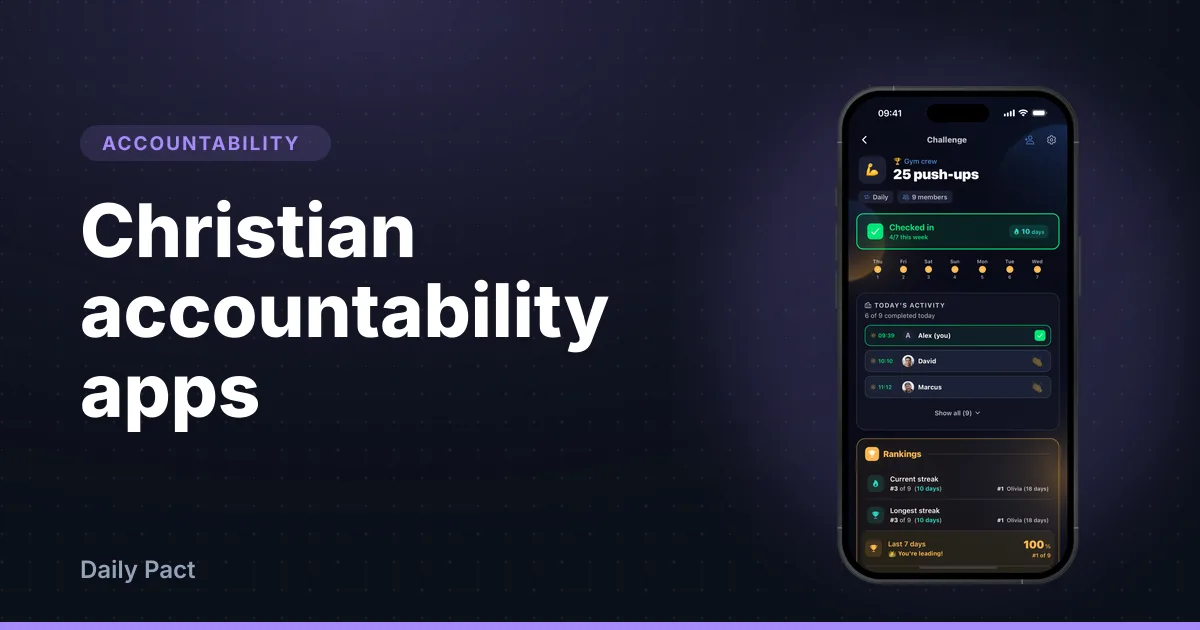
A Christian accountability app does one of two jobs. Internet accountability apps (Covenant Eyes, Ever Accountable, Accountable2You, Canopy) watch what you see on your devices and report it to a partner you trust, usually to fight pornography. Faith habit apps (YouVersion's Plans with Friends, small group apps, and group habit trackers like Daily Pact) let a group commit to a daily practice such as Bible reading or prayer and see who kept it.

Ready to build habits with friends?
Start your 14-day free trial. No credit card required.
Most people searching for "Christian accountability app" know which of those two problems they have. If you are not sure, the table below will settle it in a minute. Then: what each kind does well, where each one fails, and how to set up accountability that still works in month three.
Two kinds of Christian accountability app
| Internet accountability (monitoring) | Faith habit accountability (groups) | |
|---|---|---|
| The question it answers | "What did I look at?" | "Did I do what I said I would today?" |
| Typical use | Pornography, purity, screen habits | Bible reading, prayer, fasting, scripture memory, exercise, sobriety goals |
| How it works | Software on your phone or computer sends activity reports or alerts to a partner | Each person checks in daily, the group sees who did |
| Who sees what | Your partner sees your device activity | The group sees only the check-in, not your device |
| Examples | Covenant Eyes, Ever Accountable, Accountable2You, Canopy | YouVersion Plans with Friends, DevoteAbility, Bible Study Together, Daily Pact |
| Usually costs | Paid subscription per person or family | Free to paid; some let one leader pay for everyone |
They are not rivals. Plenty of men's groups use both: monitoring software for the struggle nobody wants to discuss at dinner, and a shared daily check-in for the habits they are building in its place.
Internet accountability apps (for purity)
These apps install on your devices and share what you do online with an accountability partner, usually a friend, mentor, pastor or spouse. The partner gets reports or alerts and is expected to follow up with a conversation.
- Covenant Eyes is the best known. It pairs screen accountability with content blocking and works across iOS, Android, Mac and Windows.
- Ever Accountable shares device activity with a partner and offers optional filtering. It runs on iPhone, Android, Windows, Mac, Chromebook and Kindle.
- Accountable2You monitors device activity and sends reports to the partners you choose, on Windows, Mac, Android, iOS, Chromebook and Linux.
- Canopy is a content filter that also has an adult accountability option.
All of these are paid subscriptions, and prices change often, so check each app's own site before you buy. Free tools are worth trying first: Screen Time on iPhone and Digital Wellbeing on Android can limit apps and content without a subscription.
What they do well: they make secrecy harder. A report going to someone you respect is a real speed bump.
Where they fail: the software only reports. As the directory faith.tools puts it, monitoring tools bring another person in, but the person is what provides the accountability. If your partner never reads the reports or never asks the hard question, nothing changes. Before you install one, agree with your partner on when you will talk (a set weekly call is better than "if something comes up") and what happens after a bad week.
If this is the help you need, start there and talk to your pastor or a counselor too. The rest of this guide is about the other kind of accountability.
Faith habit accountability apps (for groups)
The second kind of Christian accountability app is about doing something, not avoiding something. A small group agrees to read a passage every day, pray at a set time, memorize a verse a week, fast through January, or walk every morning, and the app makes it visible who did.
- YouVersion Bible App: Plans with Friends. Start any reading plan and invite friends. Everyone sees each other's progress on the plan, and a "Talk it Over" prompt at the end of each day invites discussion. Free. Its streak counts your own app use, not the group's.
- Small group and church apps such as DevoteAbility, Bible Study Together and coChurch add things like leader-assigned passages, prayer requests and group messaging. Good if your church wants one place for the whole small group's life.
- Group habit trackers like Daily Pact work for any daily practice, not just a reading plan. The group commits to the same habit, each person checks in with one tap, and everyone sees who showed up today.
The difference that matters: a Bible app is built around reading. If your group's commitment is reading through a plan together, Plans with Friends is free and does that well. If your commitment is something else, or several things (pray before work, no phone after 10pm, a walk with your spouse, a Daniel Fast), you need a tracker that does not care what the habit is.
What makes a Christian accountability app actually work
Whichever kind you choose, the same four things decide whether it helps or becomes another ignored notification.
1. One commitment, stated in one sentence. "Read one chapter of the Gospel of John every day in Lent" works. "Grow closer to God" does not, because nobody can check it. A daily yes or no is what makes accountability possible.
2. A person, not just a feed. James 5:16 asks us to confess to one another and pray for one another. An app can show that someone missed three days. Only a person can ask why and pray with them. Name an accountability partner inside the group, so every member has one specific person who notices.
3. Grace built into the rules. Decide before you start what a missed day means. In most groups the healthy answer is: it costs you the day, not the commitment. People who believe one miss ruins everything tend to disappear quietly instead of coming back. In Daily Pact you can ask your group for a PactPause before a planned break, such as a trip or a hospital stay, so the streak survives it.
4. A set end date and a set conversation. Run it for a season (21 days, Lent, Advent, a 30-day challenge) and meet at the end to talk about what changed. Then decide together whether to go again.
Faith habits that work well with a group
If your group is not sure what to commit to, start small enough that the worst day of the week still counts.
| Habit | Daily check-in | Good season |
|---|---|---|
| Read one chapter | Did you read today's chapter? | Any; a Gospel in a month |
| 10 minutes of prayer | Did you pray for 10 minutes? | Lent, Advent |
| Scripture memory | Did you review this week's verse? | 12 weeks |
| Gratitude | Did you write three things down? | November |
| Phone off at a set hour | Was your phone away by 10pm? | 30 days |
| Daily walk and pray | Did you walk and pray today? | Spring |
| Daniel Fast | Did you keep the fast today? | January, 21 days |
More ideas for the new year are in our list of Christian New Year's resolutions, and the 30-day challenge ideas work just as well for a church group.
How to set up a small group in Daily Pact
- Create a pact with the one habit your group agreed on and how long it runs.
- Invite people the way your group already talks: a link in the group chat, your contacts, a QR code on the screen on Sunday, or by email (paste up to 200 addresses and see who opened the invite and joined).
- Choose who pays. Everyone can start with the 14-day free trial, or one leader can cover the whole group with a Group plan: up to 15 people for $9.99 a month, up to 50 for $24.99, up to 200 for $49.99. Members join free and never see a paywall. Group plans have no free trial.
- Check in daily with one tap. The leaderboard shows who is keeping it, and daily reminders catch the days people would simply forget.
Daily Pact does not monitor your phone, block content or read your messages. The group only ever sees whether you checked in. If you need internet accountability, use one of the monitoring apps above alongside it.
For the people side of running a group, see how to start an accountability group.
FAQ
What is the best Christian accountability app?
It depends on what you need accountability for. For pornography and online purity, a monitoring app such as Covenant Eyes, Ever Accountable or Accountable2You that reports to a trusted partner. For Bible reading with friends, YouVersion's Plans with Friends, which is free. For any daily faith habit in a small group, a group habit tracker like Daily Pact.
Is there a free Christian accountability app?
Yes for Bible reading: YouVersion's Plans with Friends is free. Most internet monitoring apps are paid subscriptions, though Screen Time (iPhone) and Digital Wellbeing (Android) are free built-in ways to limit content. Daily Pact has a 14-day free trial, and with a Group plan members join free.
How do Christian accountability partner apps work?
Monitoring apps run on your devices and send activity reports to a partner. Habit apps ask each person to check in daily and show the group who did. In both cases the app only makes things visible. The accountability comes from a partner who follows up.
Can a church small group use an accountability app together?
Yes. Pick one daily practice, set a start and end date, and invite everyone into the same group. In Daily Pact one leader can pay for up to 200 people with a Group plan, so cost never keeps anyone out.
Do I need an app for Christian accountability?
No. A faithful friend and a weekly phone call have worked for centuries. An app helps when the group is too big or too busy to keep track by hand, or when the daily habit happens alone and nobody would otherwise know.
Ready to build habits with friends?
Start your 14-day free trial. No credit card required.