
Try Daily Pact free for 14 days
Group challenges, leaderboards & streak tracking with your friends. No credit card required.
You don't have a motivation problem. You have a consistency problem.
Most people can start a new habit. The excitement of day 1 carries you through the first week. But by week 2, the novelty wears off, life gets busy, and the habit quietly dies. Research from University College London suggests it takes an average of 66 days to form a new habit — yet most people quit before day 14.
The missing ingredient isn't more motivation. It's accountability.
Why Solo Goal-Setting Fails
When a goal exists only in your head — or in a private app — skipping has zero consequences. Nobody notices. Nobody cares. Your brain quickly rationalizes: "I'll start again tomorrow."
This is called the intention-action gap, and psychologists have studied it extensively. People consistently overestimate their ability to follow through on intentions. The gap between "I want to do this" and "I did this" is vast.
Solo strategies try to bridge this gap with tools: alarms, reminders, streak counters, habit trackers. These help — but they don't solve the core problem. When the only person you're accountable to is yourself, and you can dismiss a notification in 0.3 seconds, the system breaks down.
The Science of Social Accountability
The American Society of Training and Development (ASTD) found:
| Accountability Level | Chance of Completion |
|---|---|
| Having an idea | 10% |
| Consciously deciding to do it | 25% |
| Deciding when you'll do it | 40% |
| Planning how you'll do it | 50% |
| Committing to someone else | 65% |
| Having a specific accountability appointment | 95% |
That jump from 50% to 95% is the social accountability effect. It's not about willpower — it's about creating a social commitment that makes quitting harder than continuing.
How Social Accountability Works
Three psychological mechanisms make social accountability powerful:
1. Social Commitment
When you tell your friends "I'm working out every day this month," you create a public commitment. Breaking it means losing face. This isn't about shame — it's about identity. You've declared yourself someone who works out daily. Skipping contradicts the identity you've publicly claimed.
2. Peer Observation
Behavioral studies show that people perform better when they know they're being observed. In group challenges, every check-in is visible to the group. Your friends can see whether you showed up today. This alone makes consistency significantly more likely.
3. Positive Reinforcement Loop
When a friend completes their challenge and you get a notification, it triggers a desire to match their behavior. When you check in and someone reacts, it reinforces the behavior. Over time, these micro-interactions build intrinsic motivation — you don't just do it for others, you start doing it for yourself.
How to Set Up a Social Accountability System
You don't need anything complicated. Here's the minimum viable system:
Step 1: Find 2–5 Friends With Similar Goals
Not identical goals — similar vibes. A fitness challenge group doesn't need everyone doing the same workout. One person runs, another lifts, another does yoga. The shared commitment is daily movement, not a specific exercise.
Step 2: Pick One Challenge
Resist the urge to track 5 habits. Start with one. The constraint forces focus and makes the check-in trivial. You can always add more challenges after the first one sticks.
Step 3: Use a Dedicated Tracking System
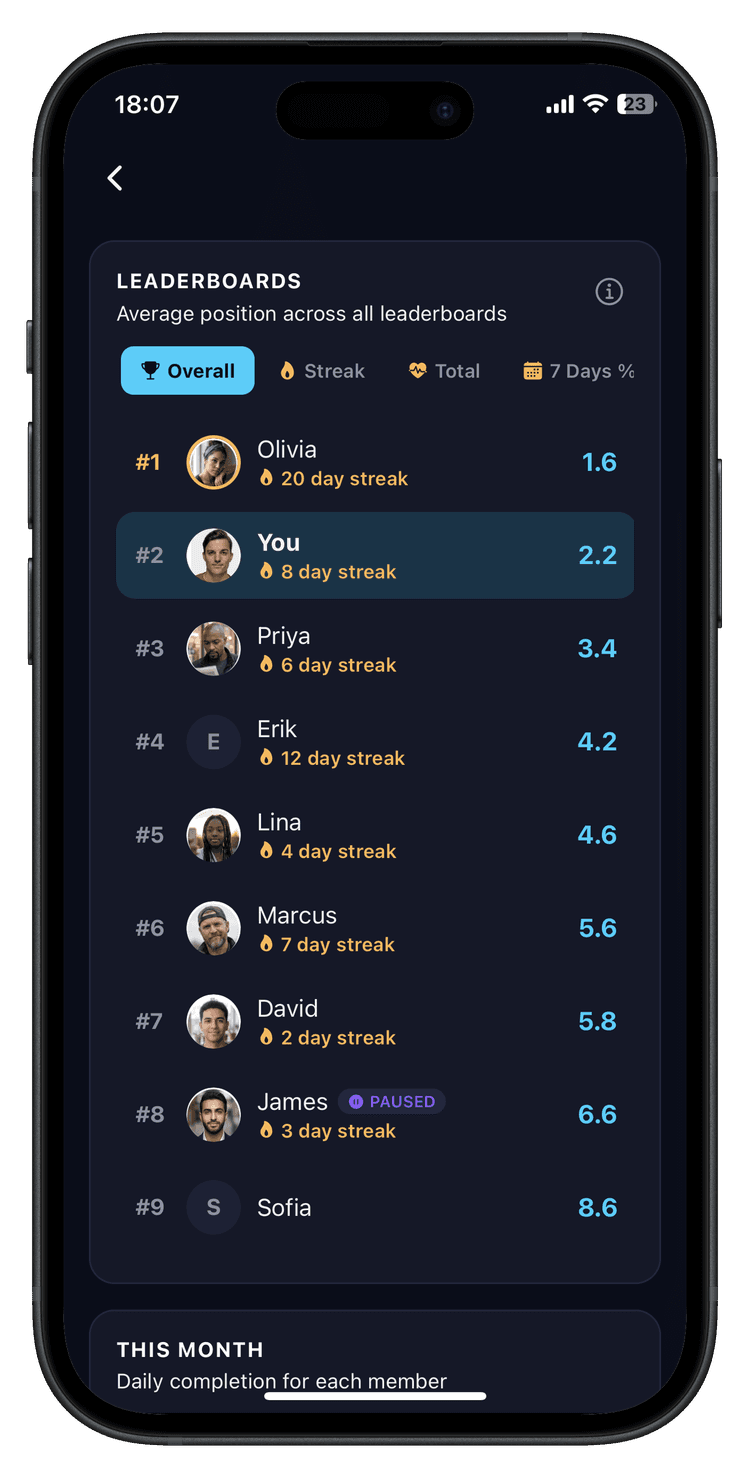
Group chats don't work — messages get buried and there's no way to track who's actually consistent over time. Use an app like Daily Pact that gives you:
- One-tap daily check-ins
- Leaderboards showing who's leading
- Streak tracking that visualizes consistency
- Push notifications when friends check in
Step 4: Check In Daily (Not Weekly)
Daily check-ins build daily habits. Weekly reviews are too infrequent — you can miss 4 days before anyone notices. A daily system catches missed days immediately and creates a routine of accountability.
Step 5: Celebrate Consistency, Not Perfection
Nobody hits 100% over 30 days. What matters is the trend. Celebrate 90% completion. Recognize someone who came back after missing two days. Use PactPause for genuinely impossible days so the system supports real life, not arbitrary perfection.
What If You Don't Have Friends Who Want to Join?
Start with two people. One friend is enough to create meaningful accountability. You can also post in communities like r/GetMotivatedBuddies or r/accountability to find accountability partners who share your goals.
Once you have 2–3 people tracking together, the dynamic takes care of itself. Each person's consistency motivates the others. The leaderboard creates natural competition. The group becomes self-sustaining.
The Bottom Line
Consistency isn't about discipline or motivation. It's about designing an environment where skipping is harder than showing up. Social accountability — having friends who can see your progress — is the most powerful consistency tool that exists.
Pick a goal. Find friends. Track together. That's it.